
A bilingual platform sign on Hong Kong's MTR · credit
Working paper, version 1.0.0 · November 2026
Cognitive effects at the interfaces
An exploratory comparative essay on linguistic architecture and the accessibility of mathematics
Rodrigo Jazinski
Abstract
Mathematical relationships do not change across languages, but the cost of reaching them may. This essay asks where, and through which mechanisms, linguistic architecture changes the cognitive cost of representing, interpreting and manipulating a mathematical relationship that itself stays fixed. Its central distinction comes from Larkin and Simon (1987): two representations can be informationally equivalent yet computationally different.
The essay does not rank languages. It treats linguistic features as task-relevant variables at five levels (numeral lexicon, grammar, register, notational interface, modality), acting through six candidate mechanisms on five outcomes (interpretation, formalisation, execution, explanation, transfer). The method is a desk-based comparative synthesis of published evidence in arithmetic, logic and geometry. The feature-driven sample covers English, Mandarin Chinese, Welsh, Russian, Arabic, Basque, Turkish, Guarani, Inuit languages, Mundurukú, Pirahã and American Sign Language. Twenty-three claims are graded under an explicit protocol, each with its principal residual confound.
Three observations organise the results. First, most well-evidenced effects sit at interfaces, the points where one representation must be converted into another: number word to digit string, grammatical number to exact quantity, habitual reading to formal reading. Away from those interfaces, in approximate magnitude and core geometric intuition, effects are weak or absent. Second, cost is often redistributed rather than removed: a language can make one step cheaper and another dearer. It is not always conserved, and some irregularity has no identifiable compensating gain. Third, the best-supported claims are the narrowest. The three that grade Strong concern transcoding errors under number-word inversion, the task-specificity of number-word transparency, and the effect of digit-name length on forward digit span. None concerns mathematical ability.
The claim is deliberately modest. For the relationships considered here, languages appear broadly intertranslatable at the level of propositional content. They differ in the availability, conventionality, ambiguity, length and alignment of the forms that express those relationships. Those differences move cognitive and educational cost between steps. They do not establish differences in mathematical capacity. The essay closes with open questions and with predictions that could fail.
Plain-language summary
The number 35 is the same everywhere, but the words for it are not.
- In English it is thirty-five.
- In Mandarin it is sān-shí-wǔ, literally “three-ten-five”, which spells out the place-value structure.
- In Basque it is hogeita hamabost, “twenty-and-fifteen”, built on twenty rather than ten.
- In Arabic it is khamsa wa-thalāthūn, “five and thirty”, with the units said first.
None of these makes 35 a different number. Each, though, gives a child a different path to the idea that 35 is three tens and five ones.
The same holds beyond counting. In Russian, the form of a noun after a numeral depends on the numeral’s last digit: 21 стол (singular), 22 стола, 25 столов. A Russian speaker’s grammar quietly tracks something arithmetical.
The reason is that the noun follows the last word of the number, not the number as a whole. Russian says 21 as “twenty one”, and it is the final word, “one”, that sets the form: 21 стол behaves like 1 стол, 22 стола like 2 стола, and 25 столов like 5 столов, however large the number grows. To choose the right ending, a speaker must in effect look at the last digit, and also notice whether the last two digits are 11 to 14, which take the same form as 5. Nobody thinks of this as arithmetic, but it is a rule about what is left over when a number is divided by ten (Section 5).
In English, “There is a number for every student” can mean one number shared by all, or a possibly different number for each. Picture a teacher handing out raffle tickets. If every ticket shows 7, there is a number for every student in the first sense. If every ticket shows a different number, there is still a number for every student, in the second sense. Logicians write these two readings differently, with the quantifiers in opposite orders. Grammars and usage conventions differ in how readily they allow such sentences to be read both ways.
In space, some languages describe position by “left” and “right”, and others by fixed bearings such as uphill or north. Some signed languages place things in the space in front of the signer, so that spatial relations are part of the grammar itself.
The essay is about natural languages: the spoken and signed languages that children acquire. Programming languages and other formal languages are left aside. They are designed systems with fixed rules of interpretation, closer to notation than to a first language, and they would need a separate analysis.
This essay collects what researchers have already found about such differences, puts it side by side in tables, and asks what it adds up to. The short answer: languages do not change what is mathematically true, nor who can do mathematics. They change where the effort falls. Some steps are made easier, others harder, and the effects are narrower than popular accounts suggest. The essay ends with the questions that remain open.
Framework · Section 1
Introduction: invariance and accessibility
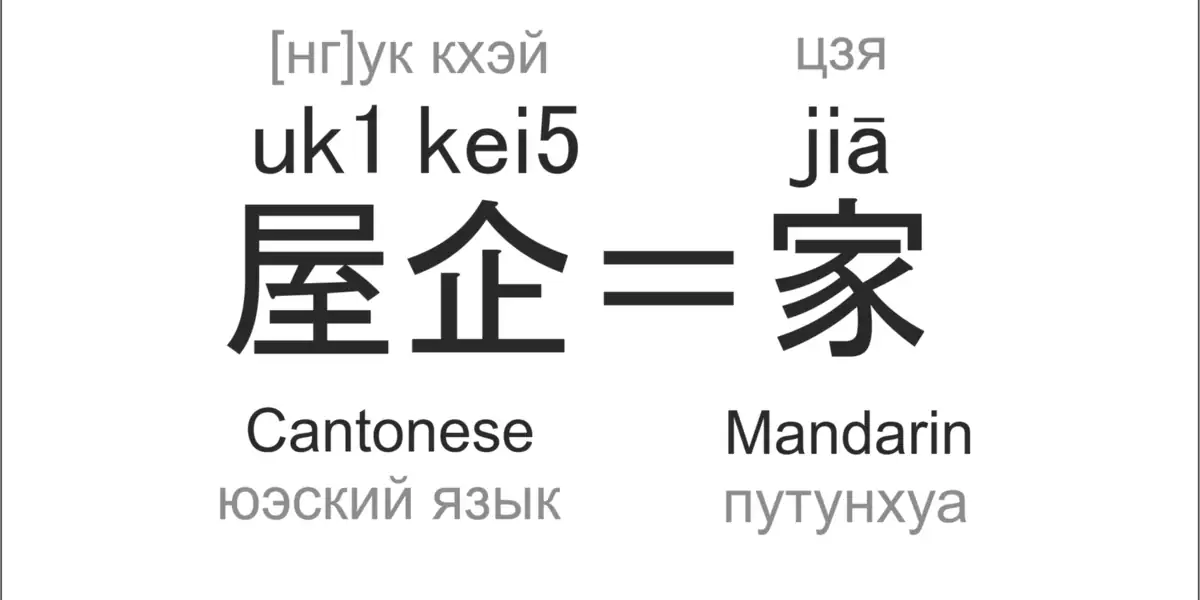
'Home' in Cantonese and in Mandarin: one meaning, two written forms · credit
Mathematics is often described as a universal language. The equation a + b = b + a holds whether it is explained in English, Russian, Mandarin or Arabic. Yet people rarely meet mathematics as bare notation. They meet it through number words, spoken explanations, written instructions, diagrams and classroom routines, all of which differ across communities.
This essay takes that gap seriously. A mathematical proposition may stay invariant while the linguistic conditions under which it is understood vary. The question is whether those conditions change how much work the understanding takes.
Informational and computational equivalence
Larkin and Simon (1987) gave this intuition a precise form. Two representations are informationally equivalent when everything inferable from one is inferable from the other. They are computationally equivalent only if, in addition, those inferences are equally quick and easy. A diagram and a list of sentences can carry the same information yet differ greatly in what a reader can see at a glance.
Zhang and Norman (1995) applied the same idea to numeration systems. Roman and Hindu-Arabic numerals encode the same numbers, but they divide the work differently between what is written on the page and what must be held in the mind. Multiplication in Roman numerals is hard not because the numbers differ, but because the notation leaves more of the work to the head.
This essay extends the distinction from written notation to natural language. Its working thesis is narrower than “languages are equivalent”. For the mathematical relationships considered here, languages appear broadly intertranslatable at the level of propositional content, but they are not computationally equivalent. They differ in the availability, conventionality, ambiguity and processing cost of the forms used to express those relationships. A language may need a paraphrase or a longer construction where another has a single word. Intertranslatability is a weaker claim than informational equivalence. It says only that, given suitable paraphrase and context, the same proposition can be expressed. It does not establish that the available expressions support the same inferences with equal directness, or that no distinction is easier to state in one language than another. It is a working assumption of this essay, not a result derived in it. The differences are local: they attach to particular features and particular tasks, not to languages as wholes.
Language and thought, without determinism
Research on linguistic relativity has moved away from the claim that language sets the boundaries of thought. The current view is that language can make some distinctions more available, more habitual or harder to ignore, and that such effects are selective rather than absolute (Wolff & Holmes, 2011).
Numerical cognition is the area where this view is best supported. Studies of number-word systems show how transparency, counting routines and notation influence the learning and manipulation of exact quantities (Göbel et al., 2011). Work on bilinguals shows that the language in which mathematics is done can affect numerical processing in the same person (Schiltz et al., 2024).
What this essay does
The essay belongs to a wider line of comparative constraint analysis: the study of how symbolic systems shape what is easy, hard or habitual to think. Mathematics is a useful limiting case for that line of work. Its content is held fixed, so any variation lies in the cost of access, not in the conclusion reached.
The question is not new, and stronger answers have been given. Barton (2008), starting from the development of a Māori mathematical vocabulary, argues that languages express everyday mathematical ideas so differently that different mathematical worlds are possible. Núñez (2017) argues that exact number is a cultural achievement and not an evolved capacity. This essay claims less than either. It holds the mathematics fixed and asks only what it costs to reach, and it takes no position on where number concepts come from. Research on multilingual classrooms treats a learner’s languages as resources for mathematics as well as obstacles. This essay takes a narrower route through cognitive cost, and stays close to experimental and developmental evidence.
The essay does not report new data. It assembles published findings, sets them side by side, grades their strength, and asks what they suggest. It aims to offer ways of seeing, and to state what would have to be true for each of them to hold.
Three observations, stated in advance
The synthesis yields three observations. Each is developed in the sections named and summarised after the evidence ledger in Section 11.
- Effects sit mostly at interfaces. The well-evidenced effects occur where one representation has to be converted into another: a spoken number into digits, a grammatical category into an exact quantity, an everyday sentence into a formal proposition (Sections 6 and 7). Where no conversion is needed, as in approximate magnitude or core geometric intuition, effects are weak or absent (Sections 6 and 8). This fits Larkin and Simon’s distinction: computational differences show up when work is done on a representation, and on this essay’s reading, converting between representations is such work.
- Cost is often redistributed, not removed. The same language can lower the cost of one step and raise the cost of another (Sections 2, 6 and 11). The pattern is common but not a law.
- The firmest claims are the narrowest. Every claim that grades Strong concerns one task. Claims about arithmetic in general, reasoning in general or spatial thinking in general grade lower or are contested (Section 11).
Two terms are used throughout in a restricted sense. Easier always means easier for a specified population, task, measure and instructional context. No claim is made that any language is globally simpler, more logical or more mathematical than another. Cost is a family-resemblance term. It may mean working-memory load, articulation time, the burden of learning irregular forms, or the inferential work of resolving an ambiguity. These are not assumed to be commensurable, only to be real constraints on specific tasks.
Framework · Section 2
Complexity without ranking
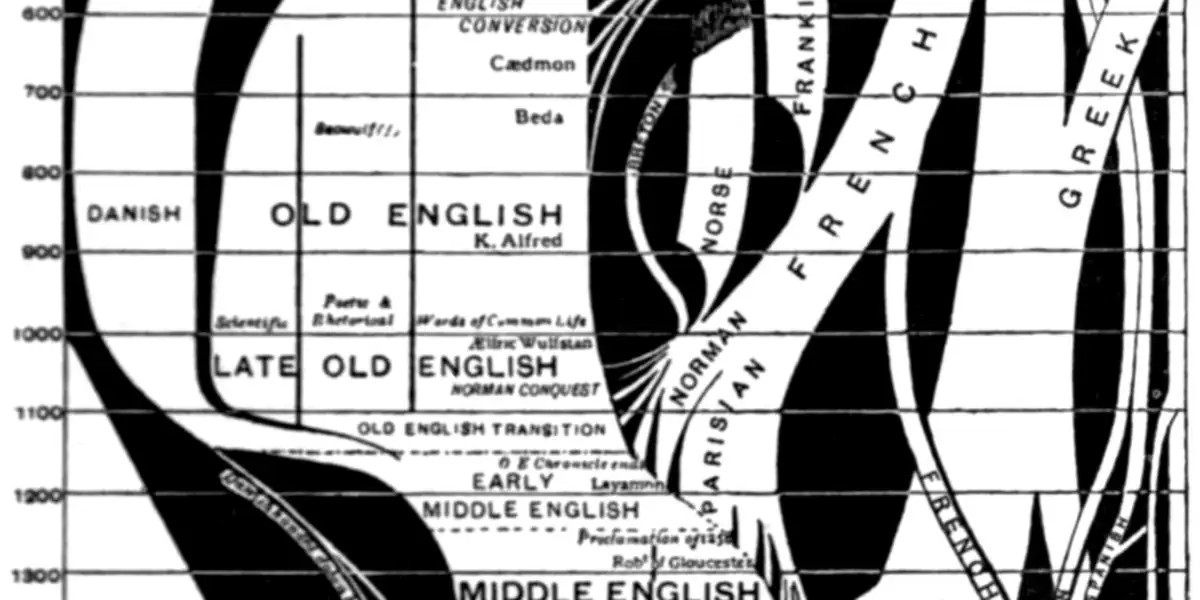
Grammatical change in English, from the Encyclopaedia Britannica (1911) · credit
Any comparative study must first ask what makes a language simple or complex. Linguistics has no agreed single measure. The equi-complexity literature suggests the question is badly posed when asked of whole languages.
Complexity is a vector, not a score
Bentz, Gutierrez-Vasques, Sozinova and Samardžić (2023) meta-analysed 28 complexity metrics applied to texts in 80 languages from 34 families. About a third of the significant correlations between measures were negative, which partly supports the idea that complexity in one domain is offset by simplicity in another. The equi-complexity hypothesis, that languages are equally complex overall, was largely confirmed. Languages differed within morphology and within syntax, but their overall complexity profiles were almost indistinguishable.
Describing Mandarin as simple, Russian as complex and English as intermediate would therefore smuggle in an undefined variable. Typological labels describe dimensions of variation, not ranks. Analytic constructions express grammatical relations through separate words and word order. Synthetic constructions pack more grammatical information into words. Agglutinative systems do so through relatively separable morphemes, and polysynthetic languages can fold whole propositions into single words (Comrie, 1989).
The consequence for method is direct. The unit of comparison is the linguistic feature operating inside a particular task, not the language as a whole.
Numeral systems as solutions to a design problem
Numeral systems have their own, better-measured complexity literature. Xu, Liu and Regier (2020) analysed 30 languages whose numeral systems range from approximate, through exact but restricted, to fully recursive. They found that systems of every type sit near an optimal trade-off between informativeness and simplicity. Mundurukú and Pirahã fall in the approximate class in their data set.
For recursive systems, which can name every integer exactly, informativeness is fixed, so a different trade-off is needed. Denić and Szymanik (2024) proposed that such systems balance two pressures: keeping the lexicon of numeral morphemes small, and keeping the average numeral short in morphemes. Across 128 languages they found attested systems close to the optimal frontier.
The claim has been tested twice since. Yang and Regier (2025) noted that the grammar used to generate the comparison systems, based on Hurford (1975), cannot produce suppletive forms such as Russian sorok, “forty”, which is not built from “four”. Adding such forms, they found that the original result held.
Cathcart and colleagues (2026) changed the coding instead. They counted every unpredictable variant of a numeral morpheme as a separate item a learner must store, so that English fif- in fifteen and fifty is not the same item as five. Across 52 languages, many systems then fell well off the efficient frontier. Most of these were Indo-European and Semitic languages with irregular teens or decades. Paraguayan Guarani was also less efficient than expected, because it mixes bases.
This debate supplies a way of seeing that runs through the rest of the essay. A numeral system that is cheap to store, with few root words, may be expensive to say or parse, with long compounds. A system with many irregular words may be expensive to learn but quick to say. Often cost moves between the lexicon, the grammar and the learner.
Cathcart and colleagues add a necessary correction: cost is not always conserved. Some systems carry irregularity whose payoff the available measures do not show. It may reflect historical accretion, contact, frequency effects, or functions the models do not capture. Redistribution is the common pattern, not a law.
An existing taxonomy to build on
The study of linguistic influences on numerical cognition already has a working taxonomy. Dowker and Nuerk (2016) distinguish lexical, syntactic, semantic and conceptual influences, together with phonological and visuo-spatial orthographic ones. They observe that most studies show that language influences number without identifying the level at which the influence operates. Bahnmueller, Nuerk and Moeller (2018) refine the taxonomy for multi-digit numbers by crossing linguistic levels with levels of place-value processing, and note that some combinations have been studied at only one level or not at all.
The framework in Section 3 adopts that concern and extends it in two directions. It moves beyond number into logic and geometry. It also adds the interface with written notation, and modality, as levels in their own right.
Framework · Section 3
A layered framework: features, mechanisms, outcomes
The Linguistic–Mathematical Comparative Constraint Matrix (LMCCM) is a chain with three links. A feature at one of five levels acts through a mechanism on one of five outcomes. Each link is stated so that the claim can fail at a specific point.
Figure 1. The LMCCM chain. Any level can in principle act through any mechanism on any outcome. The highlighted path is the best-evidenced one: number-word inversion, as in German or Arabic, produces transcoding errors when children write numbers from dictation (Section 6).
The original figure is deposited with the paper: SVG on Zenodo.
Levels: where the feature lives
| Level | What varies | Examples from the sample | Domain most affected |
|---|---|---|---|
| 1. Numeral lexicon | Base, order of tens and units, teens, suppletion, length of number words | Mandarin sān-shí-wǔ; Basque base twenty; Arabic units-first order | Arithmetic |
| 2. Grammar | Grammatical number, numeral–noun agreement, case, classifiers, quantifier scope, negation | Arabic dual; Russian last-digit agreement; Russian negative concord | Arithmetic (early number); logic |
| 3. Register and lexicon | Mathematical register, borrowed terms, words for necessity, possibility, equality | Spanish numerals in Guarani; classical versus spoken Arabic | Word problems; proof; logic |
| 4. Notational interface | Fit between spoken forms and written numerals and symbols | Kaktovik numerals; Hindu-Arabic digits read in inverted languages | Arithmetic; algebra |
| 5. Modality and spatial grammar | Speech, sign, gesture; frames of reference | ASL spatial loci; absolute versus relative frames | Geometry; spatial reasoning |
The levels are descriptive, not statistically independent. A language with an agglutinative grammar may also have a regular numeral lexicon, as Turkish does. Effects attributed to one level must therefore be tested against the others, ideally by holding the language constant and varying the task.
Level 5 does less work in this essay than the other four. Its effects are best documented in spatial cognition (Section 8). In arithmetic and logic the evidence is mostly indirect. One specific prediction would integrate it: numeral incorporation in signed languages fuses number into a noun-like sign, which may change the unit in which quantities are represented in a way that spoken compounds do not. That prediction is untested.
Level 3 is retained because mathematical language is a distinct register, with its own vocabulary, grammatical patterns and conventions (Halliday, 1978; Pimm, 1987). Within single languages the register is well studied. Rewording test items in simpler language has been reported to raise scores, most for students still learning the language of instruction (Abedi & Lord, 2001), and the linguistic and numerical difficulty of word problems interact (Daroczy et al., 2015). What is sparse is comparison of registers across languages. Apart from translation effects (Section 7) and borrowed numerals (Section 5), the level is kept as a direction for future work, and no graded claim rests on it.
Candidate mechanisms: how a feature might act
| Candidate mechanism | What it means | Example | Outcome most exposed |
|---|---|---|---|
| Transparency | The form displays the mathematical structure | “Ten-one” for 11 shows the base | Interpretation; formalisation |
| Load | The form costs more working memory or articulation time | Longer number words reduce digit span | Execution |
| Ambiguity | The form admits several mathematical readings | Quantifier scope in “a number for every student” | Interpretation |
| Alignment | Spoken order matches or mismatches written order | Units-first speech against tens-first digits | Formalisation (transcoding) |
| Scaffolding | The language supplies a ready routine or category | A grammatical dual for “exactly two” | Early learning; transfer |
| Interference | A habitual linguistic reading pulls against the formal one | Pragmatic “some” read as “not all” | Interpretation; explanation |
The mechanisms are explanatory hypotheses, not established causes. A claim in the ledger (Section 11) is graded on the evidence for its outcome. A mechanism counts as tested only when a study isolates or manipulates the linguistic feature and measures the predicted intermediate process, as the Czech inversion study does for alignment. In that study, Czech, which can say two-digit numbers in either order, let the same children write numbers dictated both ways (Pixner et al., 2011; described in Section 6). The ledger therefore reports the status of each mechanism separately from the grade of each claim.
Outcomes: what is affected
Each outcome separates a stage at which a linguistic effect could appear.
- Interpretation: whether the proposition is understood as intended.
- Formalisation: whether it can be rendered in notation.
- Execution: whether the operation is carried out correctly and how fast.
- Explanation: whether the reasoning can be articulated.
- Transfer: recognition or use of an invariant mathematical relationship after a change in surface wording, notation, language or problem context. Studies must say which change is involved, since a person may transfer across one and not another.
The central hypothesis, restated in these terms, is that features act mainly on interpretation and formalisation, less on execution once notation is supplied, and least on transfer. None of the five outcomes measures mathematical competence directly. Claims about competence are therefore extrapolations from transfer and from execution with notation supplied.
The three observations in Section 1 do not replace this hypothesis. They summarise what the evidence shows about it:
- Effects sit mostly at interfaces, where one representation is converted into another. That is where interpretation and formalisation happen.
- Cost is often redistributed, not removed. A language can make one step cheaper and another dearer.
- The firmest claims are the narrowest. Each concerns one task, not mathematical ability in general.

Framework · Section 4
Sample, method and ethics
A bank sign in several languages, 2010 · credit
The sample is chosen for the features it exposes, not to represent the world’s languages. It is split into two kinds of case.
- Evidence-bearing comparisons have published experimental or developmental studies that bear on a claim.
- Illustrative cases have well-described linguistic features but little or no cognitive evidence. They are included to show what remains untested.
Welsh is included because it offers an unusually informative within-country contrast: two counting systems coexist under broadly similar educational institutions. It is not a fully controlled natural experiment, since the medium of schooling and family background remain potentially confounded.
The sample is a feature-driven, non-probability sample. It maximises feature contrast and evidentiary leverage. It does not estimate how common any feature is among the world’s languages. Each language earns its place by supplying direct cognitive evidence, a natural contrast, or an untested but theoretically important configuration.
The sample
| Language | Family and type | Role here | Feature of interest | Main sources |
|---|---|---|---|---|
| English | Indo-European (Germanic); largely analytic | Evidence-bearing baseline | Irregular teens and decade words; obligatory singular/plural; quantifier-scope ambiguity | Miller et al. 1995; Le Corre et al. 2016; Scontras et al. 2017 |
| Mandarin Chinese | Sino-Tibetan; analytic; numeral classifiers | Evidence-bearing | Transparent decimal number names; no obligatory singular/plural; surface-scope bias in simple sentences | Mark & Dowker 2015; Le Corre et al. 2016; Scontras et al. 2017; Wu 2023 |
| Welsh | Indo-European (Celtic) | Evidence-bearing within-country contrast | Decimal school system beside a traditional vigesimal one; long digit names | Dowker et al. 2008; Ellis & Hennelly 1980 |
| Russian | Indo-European (Slavic); synthetic | Partly evidence-bearing | Noun form after a numeral set by the last digit; negative concord | Sarnecka et al. 2007; Corbett 2000; Haspelmath 2013 |
| Arabic | Afro-Asiatic (Semitic); root-and-pattern | Evidence-bearing for the dual | Dual number; units before tens; gender polarity in 3 to 10; diglossia | Almoammer et al. 2013; Ganayim, Ganayim, Dowker & Olkun 2021; Prior et al. 2015; Ryding 2005 |
| Basque | Isolate; ergative-absolutive | Illustrative | Vigesimal numerals below 100 | Hualde & Ortiz de Urbina 2003 |
| Turkish | Turkic; agglutinative | Illustrative | Fully regular tens-then-units order; noun stays singular after a numeral; grammatical evidentiality | Göksel & Kerslake 2005 |
| Guarani | Tupian; rich verbal morphology | Illustrative | Native numerals used for small numbers; Spanish numerals above; a regularised decimal system in schooling | Estigarribia 2020 |
| Inuit languages (Inuktitut; evidence from Iñupiaq) | Inuit-Yupik-Unangan (formerly Eskimo-Aleut); polysynthetic | Illustrative, via Iñupiaq | Base twenty with a sub-base of five; a notation redesigned to match it | Bartley 1997, via Marín Silva et al. 2021 |
| Mundurukú | Tupian | Evidence-bearing for exact versus approximate number and for geometry | Number words used exactly only for the smallest quantities | Pica et al. 2004; Dehaene et al. 2006; Izard et al. 2011 |
| Pirahã | Muran | Evidence-bearing but contested | No words for exact quantities | Gordon 2004; Frank et al. 2008; Everett & Madora 2012 |
| American Sign Language | Signed; visual-spatial modality | Evidence-bearing for modality | Number handshapes; numeral incorporation; spatial loci | Emmorey 2002; Berteletti et al. 2026 |
Several studies cited below use languages outside the sample, because they supply the cleanest contrasts. They include German and Czech (number-word inversion), Japanese and Slovenian (grammatical number), Belgian French Sign Language, Nicaraguan homesign and Nicaraguan Sign Language, Vietnamese and Hebrew (number words), Yucatec Maya (individuation), Korean (fraction names), Spanish and Hebrew (digit span), Tsimane’ (count range), Warlpiri and Anindilyakwa (restricted number vocabularies), German and French as languages of schooling in Luxembourg, and Tzeltal and ǂAkhoe Haiǁom (spatial frames of reference).
Method
The essay is a purposive synthesis, not a systematic review. No database search protocol was run, and no inclusion or exclusion criteria were fixed in advance.
Sources for this work were gathered through a combination of existing available literature, extensive manual search strategies, targeted subject research, and AI-assisted discovery tools (see Declarations). Null results and work not published in English are probably under-represented. Linguistic facts are taken from reference grammars, typological databases and peer-reviewed descriptions. Cognitive claims are taken from peer-reviewed experimental, developmental and cross-cultural studies, and from recent reviews.
Priority goes to designs that separate language from culture. Within-person comparisons, such as bilinguals tested in both languages, carry more weight than between-group comparisons. So do within-culture comparisons, such as children in one school system taught in different languages.
Each claim in the evidence ledger (Section 11) is graded under the protocol below. Every entry also names its principal residual confound, so that a reader can audit the grade.
| Grade | Criteria |
|---|---|
| Strong | At least three independent studies, including at least one within-person, within-school or experimentally manipulated comparison; effects in the predicted direction; no major published contradiction |
| Moderate | At least two independent studies, at least one of which partly addresses a named confound; the remaining confound is stated |
| Suggestive | One direct study, or converging indirect evidence; the missing control is stated |
| Contested | Directly conflicting results, or an unresolved methodological dispute; the dispute is named |
| Open | No direct test located; the prediction and the minimal design that would test it are stated |
Studies by the same research group count as one line of evidence unless their samples and designs differ. Grades are meant to be compared within a domain. A Strong grade in arithmetic and a Strong grade in logic rest on different kinds of study, and the scale does not make them commensurable.
The protocol counts independent studies and weighs their designs. It does not weigh sample sizes or effect sizes, which are not extracted here. A grade says how well established an effect is, not how large it is.
Linguistic descriptions in the tables are flagged where they rest on a single secondary source. Where a description is simplified, as with gender agreement in Arabic numerals, the simplification is stated.
Ethics
The essay uses published data only and collects none. Even so, how communities are described is an ethical matter. The study of number in Amazonian languages has a history of deficit framing, and the essay avoids it explicitly. The absence of words for exact quantities is a fact about a lexicon. It is not a fact about the intelligence or mathematical capacity of the people who speak that language.
The Pirahã literature is unusually contested, on both linguistic (Nevins, Pesetsky & Rodrigues, 2009) and methodological grounds, and access to the community is restricted. Findings are reported here as conditional. Guarani is a national language of Paraguay, spoken by millions, and is not treated as a small-community case. The Kaktovik numerals are credited to the Iñupiat students and teachers who designed them.
Any empirical follow-up involving Indigenous communities should be co-designed with those communities. It should follow the CARE Principles for Indigenous Data Governance (Carroll et al., 2020): collective benefit, authority to control, responsibility and ethics.
Evidence · Section 5
How languages build numbers
A page of An analytical Chinese-English dictionary (1900) · credit
The same four numbers are built in at least four different ways across the sample. Some languages count in tens or twenties, some say units before tens, and some leave the teens opaque. The tables below set these differences side by side. Glosses are literal, and forms are given in standard written or citation varieties.
Table A. The anatomy of four numbers
| Language | 11 | 35 | 53 | 97 | Base and order |
|---|---|---|---|---|---|
| Mandarin | shí-yī “ten-one” | sān-shí-wǔ “three-ten-five” | wǔ-shí-sān “five-ten-three” | jiǔ-shí-qī “nine-ten-seven” | Decimal; tens then units throughout |
| Welsh, decimal (school) | un deg un “one ten one” | tri deg pump “three ten five” | pum deg tri “five ten three” | naw deg saith “nine ten seven” | Decimal; tens then units throughout |
| Guarani, academic system | pa-teĩ “ten-one” | mbohapy-pa po “three-ten five” | po-pa mbohapy “five-ten three” | porundy-pa pokõi “(5+4)-ten (5+2)” | Decimal, with 6 to 9 built on po “hand” (five) |
| Turkish | on bir “ten one” | otuz beş “thirty five” | elli üç “fifty three” | doksan yedi “ninety seven” | Decimal; tens then units; decade words for 20 to 50 unanalysable, 60 to 90 partly transparent |
| Russian | один-на-дцать “one-on-ten” | три-дцать пять “three-ten five” | пять-десят три “five-ten three” | девяносто семь “ninety seven” | Decimal; teens units-first; 40 (сорок) and 90 are irregular |
| English | eleven (opaque) | thir-ty-five | fif-ty-three | nine-ty-seven | Decimal; teens units-first; 11 and 12 opaque |
| Arabic (MSA) | aḥada ʿashar “one ten” | khamsa wa-thalāthūn “five and thirty” | thalātha wa-khamsūn “three and fifty” | sabʿa wa-tisʿūn “seven and ninety” | Decimal; units before tens throughout |
| Basque | hamaika (opaque) | hogei-ta hamabost “twenty-and fifteen” | berrogei-ta hamahiru “two-twenty-and thirteen” | laurogei-ta hamazazpi “four-twenty-and seventeen” | Vigesimal below 100, decimal above |
| Welsh, traditional | un ar ddeg “one on ten” | pymtheg ar hugain “fifteen on twenty” | tri ar ddeg a deugain “three on ten and two-twenty” | dau ar bymtheg a phedwar ugain “two on fifteen and four twenty” | Vigesimal with sub-bases of 10 and 15; units first |
Arabic forms are masculine citation forms. In use, the numerals 3 to 10 take the opposite grammatical gender to the noun counted. Traditional Welsh forms vary (King, 2016): numbers in the fifties can also be built on hanner cant, “half-hundred”, as in hanner cant ac un, 51. The Guarani forms belong to a regularised system now used mainly in academic and school contexts. Colloquially, Spanish numerals are used above four (Estigarribia, 2020).
Three ways of seeing come out of this table.
Forms, glosses and orders as in Table A. Spoken order is shown against the written digits.
- The digit string fixes one order; languages choose others. Hindu-Arabic notation writes tens before units. Mandarin, Welsh decimal, Guarani and Turkish say them in the same order. Arabic, and the teens of English and Russian, say them reversed. Traditional Welsh says them reversed and in a different base. A child writing 35 from dictation in Arabic hears the 5 first and writes it second.
- Transparency is not one property. Turkish has a perfectly regular order, but its lower decade words are opaque: otuz, “thirty”, shows no relation to üç, “three”. Its higher decades are partly transparent (altmış, “sixty”, from altı, “six”). Mandarin and Welsh decimal are transparent in both order and decades. Basque is transparent once the base is known, but the base is twenty.
- A designed system can sit inside a language without being spoken. The Guarani academic system is more transparent than Mandarin in one respect, since even 6 to 9 are composed from five; it is also less conventional and far less used. Most speakers still say Spanish numbers. Transparency on paper does not guarantee use.
Systems not shown in Table A
Inuit languages traditionally count in twenties with a sub-base of five. In Iñupiaq, 18 is akimiaq piŋasut, “fifteen three”. Iñupiaq numerals above the small numbers were falling out of use in English-medium schooling before the Kaktovik numerals were designed (Section 10).
Mundurukú has number words for roughly one to five. Speakers use them exactly only for the smallest quantities, and approximately above that (Pica et al., 2004).
Pirahã has three words often glossed as “one”, “two” and “many”. Elicitation studies show that they are used for relative, not exact, quantities. The word glossed “one” was applied to sets as large as six in one condition (Frank et al., 2008).
American Sign Language signs 1 to 5 with extended fingers. The signs for 6 to 9 touch the thumb to a different finger, so they do not compose five-plus-one on one hand. ASL also has numeral incorporation: the handshape for a number fuses with signs such as WEEK or HOUR to give single signs meaning “three weeks” or “two hours”. Other signed languages differ. The number signs of Belgian French Sign Language follow a base-five rule while spoken French is decimal (Leybaert & Van Cutsem, 2002).
Table B. Grammatical number: what the noun does after a numeral
| Language | Grammatical number | Noun after a numeral | Evidence on early number-word learning |
|---|---|---|---|
| English | Singular, plural | Plural after any numeral above one (three books) | Children learn the meaning of “one” earlier than Japanese or Mandarin learners (Sarnecka et al., 2007; Le Corre et al., 2016) |
| Mandarin | No obligatory number marking | Numeral + classifier + noun (sān běn shū, “three [volume] book”) | “One” learned 3 to 6 months later than by English learners, despite more frequent and more transparent number words (Le Corre et al., 2016) |
| Russian | Singular, plural; six cases | Set by the final word of the numeral: 1 takes the nominative singular, 2 to 4 the genitive singular, 5 to 20 the genitive plural (21 стол, 22 стола, 25 столов) | Russian learners resemble English learners in learning “one” (Sarnecka et al., 2007) |
| Arabic | Singular, dual, plural | Dual instead of “two” (kitābān, “two books”); 3 to 10 + genitive plural; 11 to 99 + accusative singular; 100 + genitive singular | Children learning the dual learn “two” earlier than English learners (Almoammer et al., 2013, Saudi Arabic and Slovenian) |
| Turkish | Singular, plural | Singular after a numeral (üç kitap, “three book”) | No study found |
| Welsh | Singular, plural | Singular after a numeral (tri llyfr, “three book”) | No study found |
| ASL | Plural by repetition and classifiers | Numeral incorporation fuses number into the sign | Timing of access to any language, not modality, predicts number development (Santos & Cordes, 2022; Santos et al., 2023) |
The Russian row deserves a second look. In the nominative, the form of the noun follows the numeral’s last digit: 1 takes one form, 2 to 4 another, and 0 or 5 to 9 a third. The exception is the numbers ending in 11 to 14, which take the third form. Every Russian phrase pairing a numeral with a count noun quietly computes something close to n mod 10, with an exception for n mod 100. This does not make Russian speakers better at modular arithmetic; no study has asked. It shows a grammar organised around an arithmetic distinction that its speakers never need to make explicit.
Nominative forms, following the rule in Table B and the paragraph above.
Evidence · Section 6
Arithmetic: where language enters the calculation
A classroom, from Community English (1921) · credit
In arithmetic, linguistic effects cluster at the interfaces: learning the counting sequence, converting between words and digits, and recalling exact facts. They largely disappear for approximate magnitude. This is the best-evidenced domain in the essay, and also the one where popular claims most outrun the data.
Transparency helps, but narrowly
Miller, Smith, Zhu and Zhang (1995) found that Chinese and American preschoolers were about equally able to count to ten. The American children fell behind at the irregular teens, while the two groups did not differ in counting small sets of objects or in solving simple problems. In block-building tasks, children whose languages have regular counting systems were more likely to represent numbers with tens-bars plus units. Children with less regular systems were more likely to count out single cubes (Miura et al., 1993). The block-building difference may depend on how the task is presented: when the use of tens cubes was demonstrated in practice trials, differences between English- and Japanese-speaking children disappeared (Saxton & Towse, 1998).
The clean tests show the advantage is real but specific.
- Hong Kong. Mark and Dowker (2015; corrected 2016) compared Hong Kong children taught in Chinese, Hong Kong children taught in English, and children in England. The Chinese-taught children counted backward best, and both Hong Kong groups outperformed the English group on arithmetic. There was no difference in counting forward or in place-value understanding. Among older children, the Chinese-taught group also outperformed the English-taught group on arithmetic.
- Wales. Six- and eight-year-olds who spoke Welsh, at home and school or at home only, read and compared two-digit numbers more accurately than English-only peers. The groups did not differ on standardised arithmetic tests (Dowker et al., 2008). A companion comparison in the same paper complicates the picture. Tamil–English bilingual children in England, whose number words are intermediate in transparency, did better than monolingual peers on one arithmetic test and no better at comparing two-digit numbers.
A comparison of 104 Vietnamese and 104 French-speaking Belgian preschoolers found the same pattern. The transparent Vietnamese number names gave an advantage in counting and in nothing else measured, symbolic or non-symbolic (Lê & Noël, 2020).
The corrected Hong Kong result matters. The arithmetic difference between the two Hong Kong groups appears only among older children, which suggests that transparency compounds slowly or interacts with schooling. It is not a uniform head start.
Where cost moves rather than disappears
Mandarin offers the clearest case of a trade-off. Its number words are more transparent than English ones, and Mandarin-learning children hear them more often. Yet Mandarin learners grasp the exact meaning of “one” three to six months later than English learners (Le Corre et al., 2016).
A leading explanation is grammatical. English marks singular and plural on every count noun, which gives children a daily lesson in the difference between one and more than one. Mandarin does not. An English-speaking child hears one book but three books: the noun changes as soon as there is more than one. A Mandarin-speaking child hears yī běn shū and sān běn shū, “one [volume] book” and “three [volume] book”, and the noun stays the same.
Mandarin is also a classifier language, and the numeral–classifier construction may change the cues children receive for “one”. The two factors are hard to separate in current designs. Children learning a dual, as in Saudi Arabic or Slovenian, show the matching advantage for “two” (Almoammer et al., 2013).
So the same language can make one step cheaper (place value) and another dearer (the first exact number word). This is the redistribution hypothesis in its plainest form. It is also an inference across separate studies. Showing redistribution directly would need a language-by-task interaction in the same participants, tested on several outcomes at once (H2, Section 13).
Fractions: the same question, contested
Whole numbers are not the only place where words can display structure. Korean names the parts before the count: one quarter is, roughly, “of four parts, one”. Miura and colleagues (1999) found that Korean six- and seven-year-olds matched fractions to pictures better than Croatian and U.S. children before any of them had been taught fractions.
Paik and Mix (2003) re-examined the claim. Korean children did outperform U.S. peers overall. But they made the same error of treating fractions as whole numbers, and they fell to chance when a whole-number picture was among the choices. When U.S. children were given English fraction names that spelled out the part–whole relation, their scores rose above those of the Korean children.
The second experiment manipulates the wording within one language, the design that makes the Czech inversion study below persuasive. It suggests that wording matters and that wording does not explain the cross-national gap. Both halves of that sentence recur across this essay.
Inversion: when speech and digits disagree
In German, 24 is vierundzwanzig, “four-and-twenty”. When German first-graders write numbers from dictation, almost half of their errors are inversion errors, such as writing 42 for 24 (Zuber et al., 2009). Second-graders in inverting languages make more transcoding errors than those in non-inverting languages (Krinzinger et al., 2011).
Czech removes the cultural confound because it has both systems. Twenty-five can be said non-inverted or inverted. Pixner and colleagues (2011) dictated numbers to the same seven-year-olds in both forms. About half of all errors in the inverted system were inversion-related. In the non-inverted system there were hardly any.
Arabic, in the sample, says units before tens. Arabic-speaking first-graders make few lexical errors but frequent order errors, such as writing 23 for 32. These errors are rarer for whole tens and for 11 to 19, where numerical syntax matters less (Ganayim, Ganayim, Dowker & Olkun, 2021).
From primary school to university, Arabic speakers increasingly write the tens digit first when taking dictation, a strategy that varies with syntactic complexity (Ganayim & Dowker, 2021). Arabic–Hebrew bilinguals were more accurate when spoken arithmetic followed the order of the language used: inverted in Arabic, non-inverted in Hebrew (Prior et al., 2015). Diglossia, right-to-left script and school practice may still shape the pattern, and most of the Arabic evidence comes from one research group.
Three further results sharpen the picture. Inversion comes in degrees. English and Polish invert only their teens, and adults in both languages added more slowly, with a larger cost for carrying, when the numbers to be added were inverted teens (Lewis et al., 2020). The effect runs through the words. German and English speakers differ in how they compare two-digit numbers shown as digits, and that difference disappeared when participants had to keep speaking aloud, whatever the mix of items. The mix mattered on its own: with few filler items the difference was larger in German speakers, and with many it reversed (Bahnmueller et al., 2019). And transcoding matters downstream in both kinds of language. Number writing in the first year of school predicted arithmetic up to the third year about equally in German- and English-speaking children (Banfi et al., 2022). Inversion makes the conversion harder. It does not appear to make the conversion more important.
Length, memory and the language of learning
Number words also differ in length. Welsh digit names take longer to say than English ones. Welsh–English bilinguals have shorter digit spans in Welsh than in English (Ellis & Hennelly, 1980). The mechanism is articulatory load: fewer long words fit in the phonological loop.
The pattern holds across languages. Chinese digit names are shorter than English ones, and Chinese speakers have longer forward digit spans (Stigler et al., 1986). Across English, Spanish, Hebrew and Arabic, span tracks the syllabic length of the digit names and the rate at which they can be read (Naveh-Benjamin & Ayres, 1986). The effect is specific. Backward span did not differ between Chinese- and English-speaking preschoolers (Chen & Stevenson, 1988), which fits a limit on rehearsal and not a difference in numerical ability. This is the clearest effect in the essay that does not sit at an interface: nothing is converted, and the cost is simply the time the words take.
Arithmetic facts seem to be stored, at least initially, in the language in which they were learned. Bilinguals taught new exact facts in one language retrieved them faster in that language. Approximate facts transferred freely between languages (Spelke & Tsivkin, 2001).
Transfer is the least studied of the five outcomes. The closest evidence is the training study just described: trained facts did carry over to the untrained language, exact facts at a cost in speed and approximate facts freely (Spelke & Tsivkin, 2001). That is transfer of stored facts across languages, not recognition of an invariant relationship in a new problem. No study reviewed here tests the latter, so the claim that linguistic features act least on transfer remains an extrapolation.
The Luxembourg studies extend this to whole school systems. Luxembourgish pupils learn mathematics in German in primary school and in French in secondary school. Over and above proficiency, the order of German (units-tens) and French (tens-units) number words modulated bilinguals’ addition performance (Van Rinsveld et al., 2015). Simple additions were solved equally well in both languages. Complex additions were solved better and faster in German than in French, the second language of instruction (Van Rinsveld et al., 2015), and drew stronger brain activation in French (Van Rinsveld et al., 2017).
Exact cardinality and conventional number words
The sharpest evidence about language and exact number comes from people who lack conventional number words, or who know only part of a count list.
- Mundurukú adults compared and added large approximate quantities as well as French controls. They failed at exact arithmetic beyond the range of their number words (Pica et al., 2004).
- Pirahã results conflict even for the simplest task. Frank and colleagues (2008) found that Pirahã adults matched sets reliably when the objects stayed in view, and that performance broke down when an exact quantity had to be remembered across time or space. Gordon (2004) and Everett and Madora (2012) found matching above three unreliable even with the objects in view, and Everett and Madora propose an explanation for the discrepancy.
- Nicaraguan homesigners are deaf adults who live in a numerate, money-using culture but never learned a conventional language. They used finger gestures for number, yet did not reliably represent exact quantities above about three (Spaepen et al., 2011).
- Tsimane’ adults in Bolivia share one language, with a full numeral system, but differ in how far they can count. In an exact matching task with 30 adults, the point at which each person switched from exact to approximate responses was bounded by that person’s count range (Pitt, Gibson & Piantadosi, 2022).
The homesigners and the Tsimane’ are the most informative cases. The homesigners separate the effect of a conventional number language from the effect of a culture without numbers, though they also lack a linguistic community, which users of a conventional sign language have. The Tsimane’ study holds language and culture constant and varies only knowledge of the count list.
A further line of evidence takes the words away from people who have them. English-speaking adults who did the same matching tasks while repeating speech aloud fell back on approximation. A non-verbal task matched for difficulty did not have that effect (Frank et al., 2012).
Not all the evidence agrees. Butterworth, Reeve, Reynolds and Lloyd (2008) tested children who were monolingual speakers of Warlpiri or Anindilyakwa, two Australian languages with very restricted number vocabularies. On a range of exact tasks with sets of up to nine, they performed as well as English-speaking Indigenous children in Melbourne. The authors conclude that exact number concepts do not depend on number words. The discrepancy with the Amazonian and Nicaraguan results has not been resolved. The studies differ in the ages tested, in the tasks, and in how far spatial arrangement could stand in for counting.
Frank and colleagues (2008) proposed that number words act as a cognitive technology: a tool for holding exact cardinality across time, space and changes of modality. Núñez (2017) argues further that exact number is a cultural achievement rather than an evolved capacity. The opposing view holds that the concepts come first and the words are learned to fit them (Gelman & Butterworth, 2005). In the terms of this essay, the dispute is over the size of a cost. Neither side denies that counting words make exact quantities easier to keep track of and to communicate. They disagree about whether the cost of doing without them is prohibitive. None of this evidence concerns numerical thought in general, only performance on particular tasks requiring exact quantities.
Evidence · Section 7
Logic: language acts before inference
In logic, linguistic differences act mainly on interpretation: on which proposition a sentence is taken to express. Once the proposition is fixed, the evidence for differences in inference itself is weak, and what differences exist track schooling more closely than language.
Quantifier scope
Three sentences look alike but need not mean the same thing. Formalised, they come apart. In the notation, ∀ reads “for every” and ∃ reads “there is”.
| Sentence | Reading | Formal version | |
|---|---|---|---|
| (1) | Every student has a number. | Each student has a number, possibly a different one | ∀s ∃n Has(s, n) |
| (2a) | There is a number for every student. | One number is shared by all the students | ∃n ∀s Has(s, n) |
| (2b) | There is a number for every student. | Each student has a number, possibly a different one | ∀s ∃n Has(s, n) |
| (3) | There is a student for every number. | Each number has a student, possibly a different one | ∀n ∃s Has(s, n) |
Sentence (2) is ambiguous in English. The surface order of the words gives reading (2a). The inverse reading (2b) is also available and is often the one intended. Sentence (3) has the same two readings, with students and numbers swapped. The same swap separates continuity from uniform continuity: within the prefix ∀ε, the order ∀x ∃δ becomes ∃δ ∀x, so that a single δ must serve every point. In plainer terms, it is the difference between “at each point there is a tolerance that works there” and “one tolerance works at every point at once”.
Languages differ in whether, and where, they allow the inverse reading. Mandarin has long been described as scope-rigid: in simple sentences, the order of quantifiers fixes their logical order (Huang, 1982; Aoun & Li, 1993). Experiments confirm this for simple doubly quantified transitives, where native Mandarin speakers rejected inverse readings that English speakers accepted (Scontras et al., 2017).
The rigidity is not categorical. Testing 98 native speakers, Wu (2023) found inverse readings accepted when the same kind of sentence was embedded in an adverbial clause. Acceptance varied widely and fell into two clusters, which may reflect two groups of speakers with different grammars. Mandarin is better described as strongly surface-biased in simple sentences than as scope-rigid throughout.
Scontras and colleagues also tested adult heritage speakers of Mandarin whose dominant language was English. They lacked inverse scope in Mandarin, as expected, and also in English, unlike other native English speakers. The result is consistent with a scope grammar persisting or transferring between a speaker’s languages, though the study does not establish the mechanism.
For mathematics, this cuts both ways. A surface-biased language removes an ambiguity that English-speaking students must learn to manage. It also requires a speaker to reorder a sentence to express the reading that English allows by inversion.
Within English the difficulty is documented. Undergraduates often read “there exists … for all” statements as if the quantifiers came in the other order, and are guided more by the mathematical context than by the order of the words (Dubinsky & Yiparaki, 2000; Dawkins & Roh, 2020). The missing piece is the cross-linguistic comparison: the same statements given to students whose first languages handle scope differently. As far as this review found, that test has not been run.
Negation
In classical logic two negations cancel: ¬¬p is equivalent to p. Natural languages differ in how negative words combine. In Russian, Никто ничего не видел is literally “nobody nothing not saw”. Its meaning is a single negation: nobody saw anything. This is negative concord, and it is widespread across the world’s languages (Haspelmath, 2013). Standard English typically expresses a single negation with one negative word and a negative polarity item, as in “nobody saw anything”. Many non-standard English varieties use negative concord, as Russian does.
Another contrast appears in answers to negative questions. Asked “You didn’t go?”, an English speaker who did not go says “No”. In Mandarin and Japanese, the natural answer means “Right” (Mandarin duì): it confirms the proposition, not its polarity (Holmberg, 2016). The word for agreement maps onto truth in one system and onto the polarity of the sentence in the other. Neither system is illogical. They encode different relationships between a statement and its truth value.
“Some” and the pull of pragmatics
In logic, “some” means at least one and possibly all. In conversation, “some” usually implies “not all”. Noveck (2001) found that children accepted “Some giraffes have long necks” as true more often than adults. Adults more often derived the pragmatic implication that not all giraffes have long necks. The difference concerns pragmatic strengthening, not logical competence.
This is the interference mechanism from Section 3. A habitual reading pulls against the formal one, and part of learning mathematics is learning to suppress it. Scalar implicatures of this kind are found across many languages, so the effect is better seen as a cost of language in general than as a feature of particular languages.
Counterfactuals: a cautionary tale
Bloom (1981) reported that Chinese speakers were less likely than English speakers to interpret counterfactual passages counterfactually. He attributed this to Chinese lacking a dedicated counterfactual construction. Au (1983) repeated the study with more idiomatic Chinese translations, and the difference largely disappeared. Much of Bloom’s effect had come from the translations.
The lesson applies directly to any translated corpus of mathematical problems. An effect of language can be an effect of translation quality. Translations must preserve logical structure, and they need back-translation and review by native speakers who are also competent in the mathematics.
Schooling, not language
In fieldwork in Uzbekistan in 1931–32, Luria found that unschooled adults often declined to reason from premises they had not experienced. Told that all bears in the snowy Far North are white, and asked the colour of bears in a northern place they had never visited, they would say they could not know. Adults from the same communities who had some schooling, speaking the same language, were more willing to reason from such premises (Luria, 1976).
Scribner and Cole (1981) separated literacy from schooling among the Vai of Liberia, who have an indigenous script learned outside school. Syllogistic performance tracked schooling, not literacy in itself. The ability to treat a premise as hypothetical is a learned practice. It is distributed by institutions, not by grammars.
Individuation: what counts as one
Before anything can be counted or quantified, it has to be individuated. Classifier languages do not mark the count/mass distinction on nouns the way English does. Speakers of Yucatec Maya, a classifier language, classified simple objects by material more often than English speakers did (Lucy, 1992). In a word-learning task, Japanese speakers extended new names by shape less often than English speakers (Imai & Gentner, 1997). The effect is modest and task-dependent. Mandarin is also a classifier language, so the Mandarin delay in learning “one” (Section 6) may belong to the same story, linking logic back to arithmetic.
Evidence · Section 8
Geometry and space: frames before figures
Core geometric intuitions appear without geometric vocabulary. What language seems to shape is narrower and still disputed: which spatial frame a person habitually uses, and how spatial memory is organised.
Geometry without geometric words
Dehaene, Izard, Pica and Spelke (2006) tested Mundurukú children and adults, whose language has few words for geometric concepts. They detected geometric oddities among sets of figures, involving topology, parallel lines, right angles and symmetry. They could also use simple maps. Their performance resembled that of American children.
Izard and colleagues (2011) asked Mundurukú adults about lines and triangles drawn on a plane and on a sphere. Their intuitions about Euclidean properties, such as the constant sum of a triangle’s angles, were close to those of French adults. In these studies, core geometric intuitions appeared largely independently of geometric vocabulary. Some geometric competences may therefore depend less on language than exact arithmetic does, but the conclusion rests on a few studies of one population and should not yet be generalised across geometry.
Frames of reference
Languages describe location in different frames. A relative frame uses the viewer’s body: “the cup is to the left of the plate”. An absolute frame uses fixed bearings: “the cup is uphill of the plate”. An intrinsic frame uses the object itself: “in front of the car”. Speakers of Tzeltal Maya in Tenejapa, Mexico, use an uphill/downhill absolute system where English and Dutch speakers use left and right (Levinson, 2003).
In rotation tasks, people saw objects in a row, turned 180 degrees, and rebuilt the row. Tzeltal speakers tended to preserve the absolute orientation, and Dutch speakers the relative one. Levinson took this as evidence that language shapes spatial cognition.
A schematic of the task described above, with shapes in place of the objects used. Which frame people choose also shifts with landmarks and testing conditions, as the next paragraph explains.
Li and Gleitman (2002) replied that English speakers’ choices shifted with landmarks and testing conditions, so the pattern might reflect habits of the setting, not of language. Haun and colleagues (2011) compared Dutch speakers with speakers of ǂAkhoe Haiǁom in Namibia, who use an absolute frame. Spatial memory covaried with the frame each language uses, and participants found it harder to work in the frame their language did not favour. The evidence is converging but correlational and sensitive to task. Majid and colleagues (2004) read it as showing that language can restructure spatial cognition; Li and Gleitman read comparable results as effects of the testing environment, so the interpretation remains disputed. On balance it suggests that language makes some frames habitual without making others impossible.
For mathematics the link is direct. Coordinate systems are frames of reference. Whether a habitual absolute or relative frame changes how students learn coordinates, rotations or reflections does not appear to have been tested.
Signed languages and spatial grammar
In signed languages, space is part of the grammar. ASL signers set up referents at points in the space in front of them and refer back to those points. Classifier constructions depict shape, location and movement directly (Emmorey, 2002). Deaf and hearing ASL signers outperformed non-signers on some tasks of generating and transforming mental images (Emmorey, Kosslyn & Bellugi, 1993).
Nicaraguan Sign Language emerged in the 1970s and 1980s, which makes it possible to compare cohorts at different stages of a language’s growth. Second-cohort signers, whose language had developed more consistent spatial terms, outperformed first-cohort signers in searching for a hidden object, both after being disoriented and when an array was rotated. Consistent marking of left and right correlated with search after disorientation (Pyers et al., 2010). This is among the strongest evidence that spatial language supports spatial cognition, and it holds modality constant.
The design is worth spelling out. Both cohorts learned the language at the same age, but about ten years apart: the first while the language was still in its infancy, the second after it had grown more complex. When tested, the second cohort were in their 20s and the first in their 30s (Pyers et al., 2010). The two groups share a language, a community and a modality. What differs is how consistently their version of the language marks left and right, and spatial search differs with it.
The effect of language input is visible within a single language too. Children who heard more spatial words from their parents later performed better on two of three spatial tasks (Pruden, Levine & Huttenlocher, 2011). Turkish deaf children who had developed homesign without conventional spatial terms did worse on a spatial mapping task than Turkish-speaking peers (Gentner et al., 2013).
Numbers in space
Numbers also have a spatial life. Many adults respond faster to small numbers with the left hand and large ones with the right. Reading direction shapes this association. Palestinian Arabic readers showed the reverse pattern. Hebrew readers, who read words right to left but digits left to right, showed none (Shaki, Fischer & Petrusic, 2009).
A recent review argues that the association has a biological basis, citing evidence from non-human animals and human infants, which culture then orients (Eccher, Piazza & Vallortigara, 2026). This is a clear case of a layered effect: a pre-linguistic bias, a direction set by literacy, and a strength that depends on the task.
Evidence · Section 9
Comparisons that reduce confounds
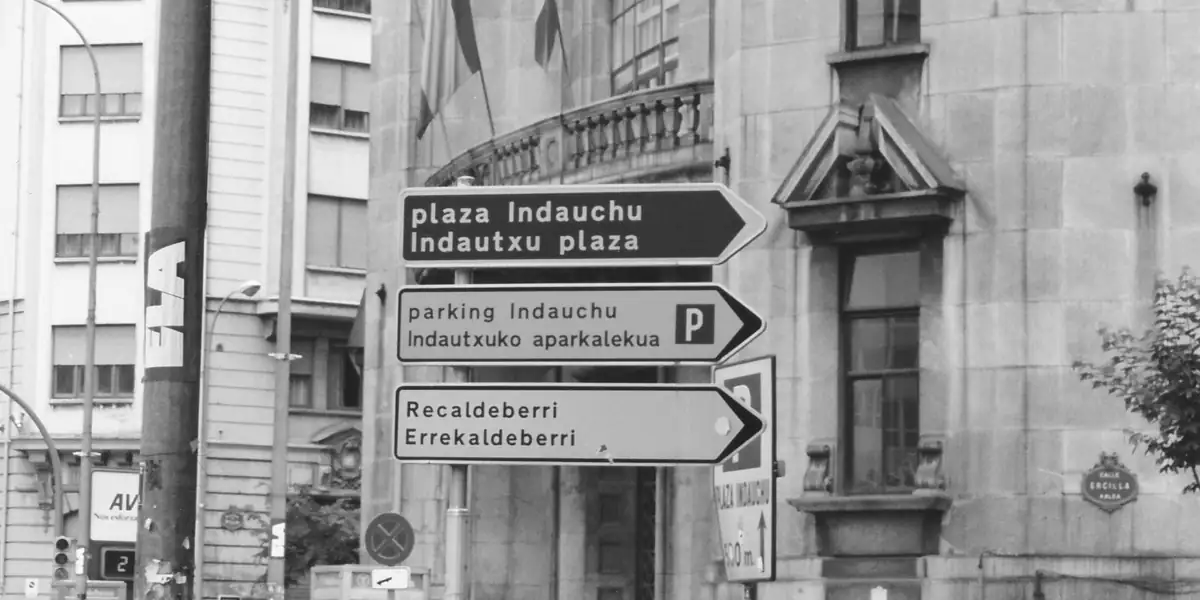
Road signs in Basque and Spanish, Bilbao, 1990 · credit
The most informative studies are those in which history has already varied the language while holding culture, schooling or the person constant. Thirteen comparisons that reduce selected confounds are gathered below; not all are natural experiments in the strict sense. Together they carry most of the weight of the evidence ledger.
| Setting | What varies | What is held constant | Finding | Source |
|---|---|---|---|---|
| Czech children | Inverted versus non-inverted number words | Same children, same language | About half of errors in the inverted form were inversion-related; hardly any in the non-inverted form | Pixner et al. 2011 |
| Arabic–Hebrew bilinguals | Spoken order of number words (inverted in Arabic, non-inverted in Hebrew) | The person | More accurate when spoken problems followed the order of the language used | Prior et al. 2015 |
| Hong Kong schools | Chinese versus English as medium of instruction | City, curriculum, home language | Chinese-taught children counted backward better; no difference in forward counting or place value; arithmetic difference only among older children | Mark & Dowker 2015, corrected 2016 |
| Welsh-medium and English-medium schools | Transparent versus irregular number words | Country, broadly the curriculum | Better reading and comparison of two-digit numbers; no difference on standardised arithmetic tests | Dowker et al. 2008 |
| Welsh–English bilinguals | Length of digit names | The person | Shorter digit span in Welsh | Ellis & Hennelly 1980 |
| Bilingual training study | Language in which exact facts were taught | The person | Exact facts retrieved faster in the language of training; approximate facts transferred | Spelke & Tsivkin 2001 |
| Luxembourg schools | German, then French, as language of mathematics | The person, the school system | Number-word order modulated addition beyond proficiency; complex sums slower in French | Van Rinsveld et al. 2015, 2017 |
| Dual-marking languages | Grammatical dual present or absent | Age; task | Earlier knowledge of “two” in Slovenian and Saudi Arabic learners | Almoammer et al. 2013 |
| Heritage Mandarin speakers | Dominant language English | The speaker’s first grammar | No inverse scope in either Mandarin or English | Scontras et al. 2017 |
| Nicaraguan homesigners | No conventional language | A numerate, money-using culture | No reliable exact representation above about three | Spaepen et al. 2011 |
| Tsimane’ adults | Individual count range | Language, culture, community | Exact matching bounded by each person’s count range; approximation beyond it | Pitt et al. 2022 |
| Nicaraguan Sign Language cohorts | Consistency of spatial terms | Modality, community | Better spatial search with more consistent spatial terms | Pyers et al. 2010 |
| Kaktovik, Alaska | Notation redesigned to match spoken base twenty | Language, community, school | Easier arithmetic reported by the teacher and in community accounts; numerals adopted in the regional curriculum; no controlled comparison | Bartley 1997, as recounted in Marín Silva, Strand & Miller 2021 |
What these settings share is a fixed point. Where the person, the school or the culture is held still, what remains is the clearest available estimate of language’s own contribution. In most of them, that contribution is real, specific to particular tasks, and smaller than between-country comparisons suggest.
The gaps are equally visible. No setting in the table involves Turkish, Basque, Guarani or Inuktitut directly, even though each offers a ready-made contrast:
- Basque–Spanish bilinguals hold a vigesimal and a decimal system in the same heads.
- Paraguayan Guarani–Spanish bilinguals mix two numeral systems in daily speech.
- Schools in Alaska’s North Slope teach with both Kaktovik and Hindu-Arabic numerals, a ready-made comparison of notations within one language community.
Evidence · Section 10
Notation as compensation, and its unequal fit
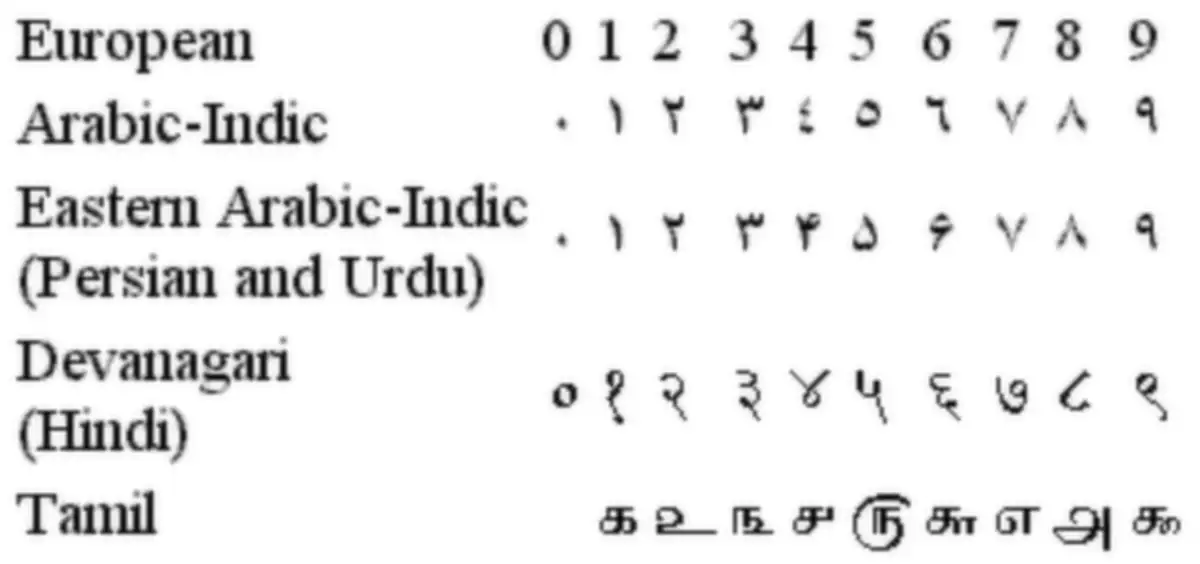
Five varieties of Hindu-Arabic numerals · credit
Written notation does reduce the burden of irregular number words, but not equally for everyone. Hindu-Arabic numerals are decimal and written tens-first. They fit some languages closely and others poorly, so the compensation they offer is itself unevenly distributed.
Notation as external representation
Zhang and Norman (1995) analysed numeration systems by how they divide information between the page and the mind. A positional system makes the base and the power of each digit visible from its place. Other systems leave some of that information to be held in memory. That is why the same number can be easy to manipulate in one notation and laborious in another.
Chrisomalis (2010) traced the history of numerical notation systems across the world. Notations have lineages of their own, largely independent of the number words of the languages that adopt them. Hindu-Arabic numerals are now a near-universal taught notation for number, learned alongside every first language in the sample.
Three relations between words and notation
| Relation | Example | What was changed | Evidence |
|---|---|---|---|
| Notation fitted to the language | Kaktovik numerals for Iñupiaq | A new base-twenty notation whose strokes mirror the spoken five-and-twenty structure | Reported by the teacher and in community accounts; adopted in the regional curriculum; not experimentally tested |
| Language fitted to the notation | Welsh decimal school numerals; Guarani academic numerals | Regular decimal number words introduced for school use | Welsh: two-digit reading and comparison advantage (Dowker et al. 2008). Guarani academic numerals: little everyday use; Spanish numerals are used above four (Estigarribia 2020) |
| Neither fitted | Arabic units-first speech; German and Czech inversion; Basque and traditional Welsh base twenty | Nothing: speech and digits disagree | Inversion-related transcoding errors (Zuber et al. 2009; Pixner et al. 2011) |
Read together, the three rows put the essay’s argument in miniature. The digit string is the same for everyone, but how much it helps depends on how well it fits the words. In the first two rows someone changed a tool to close the gap: a community redesigned a notation, and a school system redesigned the words. In the third row nothing was changed, and the gap is left for each child to bridge.
The Kaktovik numerals
In 1994, during a mathematics enrichment activity led by their teacher, William Bartley, students at the school in Kaktovik, Alaska, noticed that Iñupiaq counts in twenties. Hindu-Arabic numerals have no single symbols for 10 to 19, so writing Iñupiaq numbers was awkward. At first they added ten invented digits to the Hindu-Arabic set, but found them hard to remember. Using the pattern of Iñupiaq counting as a guide, they then designed a new set: nineteen counting digits and a distinct zero (Bartley, 1997, as recounted in Marín Silva, Strand & Miller, 2021).
Each Kaktovik digit has an upper part with up to three horizontal strokes, one for each group of five, and a lower part with up to four vertical strokes for the remaining units. The shape follows the words. Iñupiaq 18 is akimiaq piŋasut, “fifteen three”, and its digit shows three fives above three units.
A schematic after the description above: strokes for fives above, strokes for units below. Not the exact Unicode glyph shapes.
According to the teacher’s account, addition and long division became more visual, and the digits mapped directly onto a base-twenty abacus built in the school workshop. The numerals entered the curriculum of the North Slope Borough School District. They were encoded in version 15.0 of the Unicode Standard, released on 13 September 2022 (Unicode Consortium, 2022).
A worked example in the schematic digits, to show what the account describes: partial products are written in the same strokes as the divisor. It illustrates the method; it is not evidence of an effect.
These reports come from the teacher and the community, not from a controlled evaluation. They cannot separate the effect of the notation from concurrent changes in curriculum, instruction or assessment.
What the case shows is narrower. A notation was designed to make the base-twenty structure of Iñupiaq number words visually explicit, removing one identified mismatch between speech and script. Whether that lowers computational cost relative to Hindu-Arabic numerals is a testable question, not an established result.
A sharper notation hypothesis
It is often assumed that formal notation compensates for linguistic constraints. The evidence supports a sharper version. Notation compensates where it aligns with the spoken system, and adds a transcoding cost where it does not. That cost is paid mostly early, during learning, and falls hardest on speakers of languages whose number words run against the digit string.
At advanced levels, mathematics is written in natural language interleaved with notation, in a register with its own vocabulary and conventions (Halliday, 1978; Pimm, 1987). Whether the underlying natural language still matters at that level is not known. It is one of the open questions in Section 12.
Synthesis · Section 11
Evidence ledger
Of 23 claims assessed, three are strong, ten moderate, two suggestive, five contested and three open. All three strong claims are narrow: task-specific effects of transparency, inversion errors in transcoding, and the effect of digit-name length on forward digit span. None concerns mathematical ability in general.
Grades follow the protocol in Section 4 and are meant to be compared within a domain, not across domains. The mechanism-status column records separately whether a candidate mechanism has been isolated. Both columns will be revised as the evidence changes.
The three Strong grades rest on different designs. A2 rests on a within-language manipulation, the Czech study, with cross-linguistic replications. A5 rests on a within-person bilingual comparison with cross-linguistic replications. A1 rests on converging natural comparisons.
Coverage across the five outcomes is uneven. Interpretation and formalisation are the best evidenced, and execution has moderate evidence. Explanation and transfer are largely unstudied in the designs reviewed. The ledger is a map of where the evidence is, not a balanced assessment of all five outcomes. Two parts of the framework carry no graded claim at all: the register level and the explanation outcome. They stay in the framework to mark where evidence is missing.
| # | Claim | Candidate mechanism | Mechanism status | Grade | Principal residual confound | Key sources |
|---|---|---|---|---|---|---|
| A1 | Transparency effects are specific to particular tasks, not a general arithmetic advantage. Strong only under this specific wording; a general transparency advantage would grade Moderate at best | Transparency | Partly tested | Strong | Language of schooling and instructional tradition; outcome measures differ across studies. Two of the three studies share an author (Dowker); they are counted separately because their samples (Wales, Hong Kong) and designs differ | Dowker et al. 2008; Mark & Dowker 2015/2016; Lê & Noël 2020 |
| A2 | Number-word inversion produces order-specific transcoding errors | Alignment | Tested | Strong | Working-memory load co-varies with inversion. The five studies share authors (Nuerk, Moeller and colleagues); they are counted separately because their samples and designs differ | Zuber et al. 2009; Krinzinger et al. 2011; Pixner et al. 2011; Bahnmueller et al. 2019; Lewis et al. 2020 |
| A3 | Transparent number words speed counting through the teens and the reading of two-digit numbers, and incline children towards base-ten representations | Transparency | Partly tested | Moderate | Schooling and language of instruction; the base-ten representation result depends on task instructions (Saxton & Towse 1998) | Miller et al. 1995; Miura et al. 1993; Dowker et al. 2008; Saxton & Towse 1998 |
| A4 | Singular/plural and dual marking speed learning of “one” and “two” | Scaffolding | Partly tested | Moderate | Classifiers, caregiver input and input frequency co-vary with number marking | Sarnecka et al. 2007; Almoammer et al. 2013; Le Corre et al. 2016 |
| A5 | Longer digit names reduce forward digit span; backward span shows no such difference in the one study that has tested it (Chen & Stevenson 1988) | Load | Partly tested | Strong | Schooling and test familiarity may contribute to group differences; consequences for calculation are less well established | Ellis & Hennelly 1980; Stigler et al. 1986; Naveh-Benjamin & Ayres 1986; Chen & Stevenson 1988 |
| A6 | Exact arithmetic facts are initially tied to the language in which they were learned | Alignment | Tested | Moderate | Proficiency and language dominance. Held at Moderate, not Strong: the 2015 study found simple facts retrieved equally well in both languages after extended practice, so the tie weakens over time | Spelke & Tsivkin 2001; Van Rinsveld et al. 2015, 2017 |
| A7 | Reliable exact cardinality above about three or four depends on conventional number words; approximate magnitude does not | Scaffolding | Partly tested | Contested | Dispute: children speaking languages with very restricted number vocabularies matched English-speaking peers on exact tasks up to nine (Butterworth et al. 2008). Ages, tasks and available strategies differ across studies; small samples; Pirahã details contested | Pica et al. 2004; Frank et al. 2008; Spaepen et al. 2011; Frank et al. 2012; Pitt et al. 2022; Butterworth et al. 2008 |
| A8 | One language can lower one cost and raise another (Mandarin: easier place value, later “one”) | Transparency and scaffolding | Hypothesised | Suggestive | Inference across separate studies | Miller et al. 1995; Le Corre et al. 2016 |
| A9 | Arabic units-first number words are associated with order-related transcoding errors | Alignment | Partly tested | Moderate | Transcoding evidence comes from one research group (Ganayim and colleagues), in two studies with different samples and designs, counted separately under the protocol; Prior et al. 2015 adds a related order effect in spoken arithmetic, not transcoding; diglossia; script direction | Ganayim, Ganayim, Dowker & Olkun 2021; Ganayim & Dowker 2021; Prior et al. 2015 |
| A10 | Fraction names that state the part–whole relation, as in Korean, aid early understanding of fractions | Transparency | Partly tested | Contested | Dispute: explicit wording helps within English, but the Korean advantage does not track it (Paik & Mix 2003); curriculum and instruction | Miura et al. 1999; Paik & Mix 2003 |
| L1 | Mandarin speakers predominantly reject inverse scope in simple doubly quantified sentences, unlike English speakers, but accept it in some embedded clauses | Ambiguity | Descriptive claim | Moderate | Construction type, context and speaker variation | Scontras et al. 2017; Wu 2023 |
| L2 | The pragmatic reading of “some” interferes with the logical one | Interference | Partly tested | Moderate | Task framing and age | Noveck 2001; Papafragou & Musolino 2003; Bott & Noveck 2004 |
| L3 | Differences between communities in syllogistic reasoning track schooling, not language | Not linguistic: schooling | Descriptive claim | Moderate | Older studies; schooling bundles literacy, metacognitive norms and familiarity with hypothetical premises | Luria 1976; Scribner & Cole 1981 |
| L4 | Chinese speakers reason less readily about counterfactuals | Ambiguity (translation) | Hypothesised | Contested | Translation quality | Bloom 1981; Au 1983 |
| L5 | Partial scope rigidity affects how students formalise quantified mathematical statements | Ambiguity | Hypothesised | Open | No cross-linguistic test; minimal design under H1 in Section 13 | No direct test found. Nearest evidence, English only: Dubinsky & Yiparaki 2000; Dawkins & Roh 2020 |
| L6 | Negative concord, or truth-based answer systems, affect reasoning about negation in mathematics | Interference | Hypothesised | Open | Untested | No direct test found |
| G1 | Core geometric intuitions arise without geometric vocabulary | Not linguistic | Descriptive claim | Moderate | One population; task familiarity | Dehaene et al. 2006; Izard et al. 2011 |
| G2 | Language shapes habitual frames of reference and spatial memory | Scaffolding | Hypothesised | Contested | Task demands, ecological familiarity, and how frames of reference are operationalised | Levinson 2003; Li & Gleitman 2002; Haun et al. 2011 |
| G3 | Spatial language supports spatial cognition | Scaffolding | Partly tested | Moderate | Timing of language access differs across deaf groups | Pyers et al. 2010; Pruden et al. 2011; Gentner et al. 2013 |
| G4 | Reading direction orients spatial–numerical associations | Alignment | Partly tested | Moderate | Task type; biological predisposition | Shaki et al. 2009; Eccher et al. 2026 |
| G5 | Language modality itself, rather than timing of language access, affects number development | Scaffolding | Hypothesised | Contested | Dispute: Santos & Cordes 2022 and Santos et al. 2023 attribute differences in number development to the timing of language access, not to modality; age of language access is confounded with modality in the available samples | Santos & Cordes 2022; Santos et al. 2023; Berteletti et al. 2026 |
| N1 | A notation designed to match a spoken base may reduce an identified mismatch; an arithmetic advantage is not yet shown | Alignment | Hypothesised | Suggestive | Rests on uncontrolled, second-hand reports, not on a study; concurrent changes in curriculum and instruction | Bartley 1997, via Marín Silva et al. 2021 |
| N2 | The underlying natural language still matters in advanced mathematics and proof | Unknown | Hypothesised | Open | Untested | No direct test found |
Reading the ledger: three observations
Interfaces. Sorted by the conversion each claim involves, the ledger looks like this.
| Interface | What has to be converted | Claims | Best grade |
|---|---|---|---|
| Word to digit | A spoken number into a digit string, or back | A2, A9, N1 | Strong |
| Word to structure | A number or fraction name into its base or part–whole structure | A1, A3, A10 | Strong, for task-specific effects only |
| Grammar to quantity | A grammatical category (singular, dual) into an exact number concept | A4 | Moderate |
| Count list to exact set | A counting routine into an exact cardinality | A7 | Contested |
| Language of learning to language of use | A stored fact into the other language | A6 | Moderate |
| Sentence to proposition | An everyday sentence into one logical form | L1, L2, L5 | Moderate |
| Script to space | Reading direction into a spatial ordering of number | G4 | Moderate |
| No conversion | Approximate magnitude; core geometric intuition | A7 (approximate part), G1 | No linguistic effect found |
One well-evidenced effect falls outside the pattern. The effect of digit-name length on span (A5) involves no conversion at all. It is a plain cost of load. The interface observation is therefore a description of where most of the evidence lies, not a rule.
Redistribution. Table C sets out the cost profile of five cases across five steps. Cells with a claim number report a graded claim; cells without one describe the number words themselves (Section 5). A dash means no evidence was located, not that there is no effect. The table is not a ranking.
Table C. Partial cost profiles
| Spoken order against digit order | Structure visible in the number words | First exact number words | Digit-name length | Quantifier scope | |
|---|---|---|---|---|---|
| Mandarin | Aligned | Transparent: counting through the teens is faster (A3) | “One” learned later than in English (A4) | Short: longer forward span (A5) | Surface-biased: less ambiguity to manage, less freedom of order (L1) |
| English | Aligned above 20; teens reversed | Irregular teens and decades | “One” learned earlier (A4) | Shorter than Welsh or Arabic, longer than Chinese (A5) | Inverse scope available: an ambiguity to manage (L1) |
| Welsh, decimal | Aligned | Transparent: better reading and comparison of two-digit numbers, no general arithmetic gain (A1, A3) | — | Long: shorter forward span (A5) | — |
| Arabic | Reversed: order errors in transcoding (A9) | Regular decades | Dual: “two” learned earlier (A4, Saudi Arabic) | Longer than English: shorter forward span (A5) | — |
| German and Czech (outside the sample) | Reversed: inversion errors (A2) | — | — | — | — |
No row is cheap in every column. Mandarin is transparent and brief, and slower to yield “one”. Welsh decimal numerals are transparent and long. Arabic gives an early “two” and a reversed order. The cells come from different studies, ages and populations and cannot be added up, so the table illustrates redistribution and does not measure it. The direct claim (A8) remains Suggestive, and H2 in Section 13 is the test.
Narrowness. Each Strong claim names one task: writing numbers from dictation, reading and comparing two-digit numbers, repeating digits forward. Claims at the scale of a domain, such as a general arithmetic advantage or an effect of language on reasoning as such, are Moderate at best, Contested, or attributed to schooling (L3).

Synthesis · Section 12
Open questions
Title page of Arte de la lengua guaraní, Antonio Ruiz de Montoya · credit
The evidence answers fewer questions than it raises. The questions below are the ones this comparison makes visible. Some are directly testable; others are speculative and marked as such.
Numbers
- Does a grammar that tracks the last digit teach anything? Russian agreement follows something close to n mod 10: the remainder left when a number is divided by ten, which for a whole number is simply its last digit (21 leaves 1, 22 leaves 2, 25 leaves 5). As Section 5 showed, a Russian speaker choosing a noun form is in effect checking that remainder, with an exception when the last two digits are 11 to 14. Do Russian speakers find residues, divisibility by ten or the periodicity of last digits more intuitive? No study appears to have asked. A minimal test would ask Russian and English speakers to sort numerals by their last digit under time pressure. If the grammar matters, Russian speakers should show a boundary between endings in 2 to 4 and endings in 5 to 9 that English speakers lack.
- What does units-first speech cost a reader of right-to-left script? Arabic says 35 as “five and thirty”, writes its words right to left, and writes its digits tens-first. Arabic-speaking children do make order-related transcoding errors (Ganayim, Ganayim, Dowker & Olkun, 2021). What remains open is whether script direction and diglossia compound or cancel the effect, and how its course through schooling compares with German or Czech.
- Does carrying two bases make the idea of a base easier? Basque–Spanish bilinguals hold a vigesimal (base-twenty) and a decimal (base-ten) system, and Kaktovik learners work in base twenty and base ten. Accounts of the Kaktovik project suggest such pupils may gain something like a bilingual advantage. That claim is untested.
- Why does a transparent system go unused? Guarani’s academic numerals are more transparent than Mandarin’s in one respect, yet Spanish numbers dominate everyday speech. Part of a numeral system’s cost, it seems, is social: who else uses it, in which markets and on which forms. Cathcart and colleagues (2026) also found the Guarani system, which mixes bases, less efficient than its lexicon size predicts.
- Do efficiency measures for numeral systems predict what children find hard? Denić and Szymanik’s lexicon size and average numeral length describe a system’s cost. Cathcart and colleagues’ coding of unpredictable variants is a closer proxy for what a learner must memorise. Whether either measure matches a child’s learning curve has not been tested.
- Is there a numeral system optimised for learners rather than for communication? Kaktovik and the Guarani academic system are two deliberate designs, aimed in opposite directions. They could be compared directly.
Logic
- Does partial scope rigidity change how ∀∃ statements are learned? ∀ reads “for every” and ∃ “there is”. A ∀∃ statement says that for every x there is some y, which may depend on x; an ∃∀ statement says that one y works for every x (Section 7). The definitions of continuity and uniform continuity differ only in quantifier order. Mandarin fixes quantifier order in simple sentences but allows inverse readings in some embedded clauses (Wu, 2023). Does that partial rigidity help or hinder students learning the distinction? English-speaking undergraduates find the ∃∀ order hard (Dubinsky & Yiparaki, 2000), which gives a baseline to compare against. The comparison group would be Mandarin-dominant students with matched mathematical training, given the same definitions and asked to apply them to unfamiliar functions (H1, Section 13).
- Does negative concord make ¬¬p = p feel stranger? In logic, ¬¬p = p says that two negations cancel. Under negative concord, as in Russian, two negative words express a single negation (Section 7). Students whose language stacks negatives in this way meet a formal system in which negatives cancel. Truth-based answer systems, as in Mandarin and Japanese, may in turn map more directly onto truth tables.
- Do grammatical evidentials bear on proof? (Speculative.) Turkish marks on the verb whether a statement was witnessed or inferred. Proof is a genre of inferred certainty. Does a grammar that routinely marks the source of knowledge shape how proof is understood?
- Does grammatical clusivity bear on set membership? (Speculative.) Guarani distinguishes ñande, “we including you”, from ore, “we excluding you”. The language marks whether the addressee belongs to a set every time “we” is used.
Space, modality and register
- Do absolute-frame speakers learn coordinates and reflections differently? Absolute-frame speakers describe location by fixed bearings such as uphill, not by left and right (Section 8). Coordinate systems are frames of reference, so the frames-of-reference debate has a direct classroom test.
- Does spatial grammar help with variables? ASL signers assign referents to points in space and refer back to them. Algebra assigns quantities to letters and refers back to them. The analogy is untested.
- What happens to word problems in a polysynthetic language? When a whole clause can be a single Inuktitut word, the packaging of a word problem’s information is different. Whether that changes working-memory demands is unknown.
- Does the first language leave a trace in advanced mathematics? Proofs are written in natural language with notation embedded. Whether the writer’s first language affects conjecture, definition or proof style has not been studied systematically. One route is a corpus of proofs written by the same mathematicians in their first and second languages, compared for how they order quantifiers and mark inference.
Discovery
- Do number systems shape which patterns get noticed? (Speculative.) Do languages affect the discoverability of mathematical structure, and not only the cost of learning it? The history of notation offers material for that question: Babylonian base sixty, Maya base twenty, Chinese rod numerals and Indian place value. It offers no controlled evidence. The question is kept open as a way of seeing, not as a claim.
An illustration for question 15, not evidence. Glyphs are drawn schematically: Babylonian scribes grouped wedges in more than one way, the Maya calendar count used 360 rather than 400 in its third place, Babylonian and early rod numerals left an empty place blank, and the Kaktovik digits follow the description in Section 10.
Synthesis · Section 13
What would test this
A school library, from Community English (1921) · credit
Each hypothesis below names the result that would count against it. A hypothesis that linguistic effects may occur cannot be contradicted by any result. These versions can fail.
| Hypothesis | Prediction | Design | Disconfirming result |
|---|---|---|---|
| H1. Domain dependence | Number-word transparency predicts transcoding and place-value tasks but not quantifier-scope interpretation; surface-scope bias predicts the reverse | Mandarin–English bilinguals do both task families in both languages | Transparency predicts scope interpretation as well, or no double dissociation appears |
| H2. Redistribution | Each language shows a different profile across the five outcomes, with no uniform advantage | Within-person comparison across interpretation, formalisation, execution, explanation and transfer; the test is a language-by-outcome interaction in the same participants | One language is better on every outcome, or no language differs on any |
| H3. Transparency is linguistic | The transparency advantage appears when numbers are spoken and shrinks when they are shown only as digits | Same children, same items, spoken versus digit-only presentation, with the digit-only task hard enough to stay off ceiling | An equal advantage under digit-only presentation, which would weaken the linguistic interpretation without identifying schooling or culture as the cause |
| H4. Notation alignment | Transcoding errors track the mismatch between spoken order and digit order, and fall as notation familiarity rises | Arabic, German and inverted Czech versus Mandarin, Turkish and non-inverted Czech | Errors do not fall with notation exposure, or fall at the same rate whatever the spoken order |
| H5. Stage of effect | Linguistic effects are largest at interpretation and formalisation, and smaller at execution once notation is supplied | The same problems given as words and as notation, with errors coded by stage | Effects are as large when the notation is supplied as when it must be built |
H2 and the central hypothesis of Section 3 are related but distinct. H2 tests redistribution itself: no language is uniformly advantaged. The central hypothesis predicts the shape of that redistribution, with the largest effects at interpretation and formalisation. Both could hold, or H2 could hold while the predicted shape fails. H5 is the direct test of that shape.
Part of H4 already has support. Arabic-speaking children make order-related transcoding errors, as German and Czech children do (Section 6). The untested part is whether those errors fall with notation familiarity at the rate the hypothesis predicts.
Design principles
- Within-person first. Bilinguals tested in both languages, and children tested in both forms of one language as in the Czech study, control for culture and schooling at a stroke.
- Minimal pairs. Items should differ in one linguistic feature and nothing else. Transcoding items such as 35, 53 and 305 separate inversion errors (writing 53 for 35) from syntactic errors (writing 3005 for 305).
- Translation as a variable. Following Au’s reply to Bloom, every item needs independent translation, back-translation, and review by speakers who are also competent in the mathematics.
- Stage coding. Errors should be classified by the outcome at which they occur, so that interpretation errors are not counted as failures of reasoning. Coders should agree on the scheme, and show that they apply it alike, before the data are scored.
- Measured controls. Proficiency in each language, age of acquisition, language of schooling in mathematics, socioeconomic status and non-verbal reasoning.
- Preregistration. Predictions, exclusions and analyses fixed in advance.
The untapped settings named in Section 9 are the natural sites: Basque–Spanish schools, Paraguayan Guarani–Spanish classrooms, and Iñupiaq classrooms using both notations. Each should be studied only in partnership with the communities concerned.
Synthesis · Section 14
Limitations, scope and closing
A bilingual Welsh and English signpost, Bangor, 2023 · credit
Limitations
- Selection. This is a purposive synthesis, not a systematic review. It favours well-known, English-language, peer-reviewed work, and it may miss studies that would change a grade. No search protocol was used (Section 4). The ledger should be read as provisional.
- Uneven coverage. Arithmetic is far better studied than logic or geometry, and early childhood far better than adult or advanced mathematics. Conclusions about later learning are extrapolations. Nothing here shows that linguistic architecture matters at expert level. That is an open question (N2).
- Counting, not weighing. The grading protocol counts independent studies and weighs designs. It does not extract sample sizes or effect sizes, and several of the underlying studies are small. No grade should be read as a statement about the size or educational importance of an effect.
- Simplified linguistic descriptions. Arabic is treated in its standard written form, though children learn spoken varieties first. Inuit numerals are illustrated from Iñupiaq, not Inuktitut. Regional and register variation is set aside throughout.
- Residual confounds. Even the comparisons in Section 9 are imperfect. Families choose schools, and a school’s medium of instruction can correlate with family background.
- Small and contested samples. The Amazonian studies rest on small populations, some studied by few research teams, and the Pirahã findings in particular remain disputed.
- Authorship. The author is not a specialist in every field touched here. All 102 references were checked bibliographically before release, and corrections are welcome in later versions. The paper has one author and has not been through journal peer review.
Scope
The essay makes no claim that any language is more or less mathematical, nor that any community is more or less capable. Its claims concern specific steps, such as transcoding a number, learning the meaning of “one” or interpreting a quantifier. They concern costs, not ceilings. The languages compared are natural languages, spoken or signed. Programming languages and other designed formal languages are outside the scope of the essay.
Closing
Mathematical universality and linguistic variation do not contradict each other. A relationship can stay invariant while the work of reaching it varies. For the mathematics considered here, languages are broadly intertranslatable in content and computationally different in narrow, identifiable places. Most of those places are interfaces: between word and digit, between grammar and quantity, between a habitual reading and a formal one.
The cost of reaching a mathematical idea often moves: from the lexicon to the grammar, from the learner to the notation, from one stage of a problem to another. Sometimes it is simply carried, as irregularity whose payoff, if there is one, the available measures do not show.
Are linguistic constraints obstacles or resources? The cases reviewed here suggest that the answer depends partly on whether anyone redesigns the tools. Welsh-medium schooling adopted a regular decimal count. Students in Kaktovik redesigned a notation. Paik and Mix reworded a fraction. In each case a cost that had been located could be moved, though only the Welsh and fraction cases have been measured. That is the practical reason to map where the costs fall, and the reason this map is offered with its gaps showing.

References
Chronological table of the periods and dialects of English, Encyclopaedia Britannica (1911) · credit
Every reference links to the work itself where a public link could be verified: a DOI, the publisher's page, or an open record. Four entries could not be matched to a verified page and link to a search instead.
- Abedi, J., & Lord, C. (2001). The language factor in mathematics tests. Applied Measurement in Education, 14(3), 219–234. Source
- Almoammer, A., Sullivan, J., Donlan, C., Marušič, F., Žaucer, R., O’Donnell, T., & Barner, D. (2013). Grammatical morphology as a source of early number word meanings. Proceedings of the National Academy of Sciences, 110(46), 18448–18453. doi:10.1073/pnas.1313652110 Source
- Aoun, J., & Li, Y.-H. A. (1993). Syntax of Scope. MIT Press. Search
- Au, T. K. (1983). Chinese and English counterfactuals: The Sapir-Whorf hypothesis revisited. Cognition, 15(1–3), 155–187. Source
- Bahnmueller, J., Maier, C. A., Göbel, S. M., & Moeller, K. (2019). Direct evidence for linguistic influences in two-digit number processing. Journal of Experimental Psychology: Learning, Memory, and Cognition, 45(6), 1142–1150. doi:10.1037/xlm0000642 Source
- Bahnmueller, J., Nuerk, H.-C., & Moeller, K. (2018). A taxonomy proposal for types of interactions of language and place-value processing in multi-digit numbers. Frontiers in Psychology, 9, 1024. doi:10.3389/fpsyg.2018.01024 Source
- Banfi, C., Clayton, F. J., Steiner, A. F., Finke, S., Kemény, F., Landerl, K., & Göbel, S. M. (2022). Transcoding counts: Longitudinal contribution of number writing to arithmetic in different languages. Journal of Experimental Child Psychology, 223, 105482. doi:10.1016/j.jecp.2022.105482 Source
- Bartley, W. C. (1997). Making the old way count. Sharing Our Pathways, 2(1). Cited as recounted in Marín Silva, Strand & Miller (2021); the primary source was not consulted directly. Source
- Barton, B. (2008). The Language of Mathematics: Telling Mathematical Tales. Springer. doi:10.1007/978-0-387-72859-9 Source
- Bentz, C., Gutierrez-Vasques, X., Sozinova, O., & Samardžić, T. (2023). Complexity trade-offs and equi-complexity in natural languages: A meta-analysis. Linguistics Vanguard, 9(s1), 9–25. Online 2022. doi:10.1515/lingvan-2021-0054 Source
- Berteletti, I., Andin, J., Langdon, C., & Berch, D. B. (2026). Influences of spoken and signed language on numerical cognition. Nature Reviews Psychology, 5, 157–172. doi:10.1038/s44159-025-00530-1 Source
- Bloom, A. H. (1981). The Linguistic Shaping of Thought: A Study in the Impact of Language on Thinking in China and the West. Erlbaum. Source
- Bott, L., & Noveck, I. A. (2004). Some utterances are underinformative: The onset and time course of scalar inferences. Journal of Memory and Language, 51(3), 437–457. Source
- Butterworth, B., Reeve, R., Reynolds, F., & Lloyd, D. (2008). Numerical thought with and without words: Evidence from indigenous Australian children. Proceedings of the National Academy of Sciences, 105(35), 13179–13184. Source
- Carroll, S. R., Garba, I., Figueroa-Rodríguez, O. L., Holbrook, J., Lovett, R., Materechera, S., Parsons, M., Raseroka, K., Rodriguez-Lonebear, D., Rowe, R., Sara, R., Walker, J. D., Anderson, J., & Hudson, M. (2020). The CARE principles for Indigenous data governance. Data Science Journal, 19, 43. Source
- Cathcart, C., Rubehn, A., Bocklage, K., Ciucci, L., van Dam, K. P., Kučerová, A., Mažara, J., Meloni, C. Y., Snee, D., & List, J.-M. (2026). How communicatively optimal are exact numeral systems? Once more on lexicon size and morphosyntactic complexity. In G. Boleda et al. (Eds.), Proceedings of the 48th Annual Conference of the Cognitive Science Society (pp. 2774–2781). https://escholarship.org/content/qt4hz9j5f8/qt4hz9j5f8.pdf Source
- Chen, C., & Stevenson, H. W. (1988). Cross-linguistic differences in digit span of preschool children. Journal of Experimental Child Psychology, 46(1), 150–158. Source
- Chrisomalis, S. (2010). Numerical Notation: A Comparative History. Cambridge University Press. Source
- Comrie, B. (1989). Language Universals and Linguistic Typology: Syntax and Morphology (2nd ed.). University of Chicago Press. Source
- Corbett, G. G. (2000). Number. Cambridge University Press. Source
- Daroczy, G., Wolska, M., Meurers, W. D., & Nuerk, H.-C. (2015). Word problems: A review of linguistic and numerical factors contributing to their difficulty. Frontiers in Psychology, 6, 348. Source
- Dawkins, P. C., & Roh, K. H. (2020). Assessing the influence of syntax, semantics, and pragmatics in student interpretation of multiply quantified statements in mathematics. International Journal of Research in Undergraduate Mathematics Education, 6(1), 1–22. doi:10.1007/s40753-019-00097-2 Source
- Dehaene, S., Izard, V., Pica, P., & Spelke, E. (2006). Core knowledge of geometry in an Amazonian indigene group. Science, 311(5759), 381–384. Source
- Denić, M., & Szymanik, J. (2024). Recursive numeral systems optimize the trade-off between lexicon size and average morphosyntactic complexity. Cognitive Science, 48(3), e13424. doi:10.1111/cogs.13424 Source
- Dowker, A., Bala, S., & Lloyd, D. (2008). Linguistic influences on mathematical development: How important is the transparency of the counting system? Philosophical Psychology, 21(4), 523–538. doi:10.1080/09515080802285511 Source
- Dowker, A., & Nuerk, H.-C. (2016). Editorial: Linguistic influences on mathematics. Frontiers in Psychology, 7, 1035. doi:10.3389/fpsyg.2016.01035 Source
- Dubinsky, E., & Yiparaki, O. (2000). On student understanding of AE and EA quantification. In E. Dubinsky, A. H. Schoenfeld, & J. Kaput (Eds.), Research in Collegiate Mathematics Education IV (pp. 239–289). American Mathematical Society. Source
- Eccher, E., Piazza, M., & Vallortigara, G. (2026). The interplay between culture, task and biology in spatial–numerical associations. Nature Reviews Psychology, 5(8), 531–545. doi:10.1038/s44159-026-00591-w Source
- Ellis, N. C., & Hennelly, R. A. (1980). A bilingual word-length effect: Implications for intelligence testing and the relative ease of mental calculation in Welsh and English. British Journal of Psychology, 71(1), 43–51. doi:10.1111/j.2044-8295.1980.tb02728.x Source
- Emmorey, K. (2002). Language, Cognition, and the Brain: Insights from Sign Language Research. Erlbaum. Source
- Emmorey, K., Kosslyn, S. M., & Bellugi, U. (1993). Visual imagery and visual-spatial language: Enhanced imagery abilities in deaf and hearing ASL signers. Cognition, 46(2), 139–181. Source
- Estigarribia, B. (2020). A Grammar of Paraguayan Guarani. UCL Press. Numerals consulted via the summary at Omniglot, https://omniglot.com/language/numbers/guarani.htm. Source
- Everett, C., & Madora, K. (2012). Quantity recognition among speakers of an anumeric language. Cognitive Science, 36(1), 130–141. Source
- Frank, M. C., Everett, D. L., Fedorenko, E., & Gibson, E. (2008). Number as a cognitive technology: Evidence from Pirahã language and cognition. Cognition, 108(3), 819–824. Source
- Frank, M. C., Fedorenko, E., Lai, P., Saxe, R., & Gibson, E. (2012). Verbal interference suppresses exact numerical representation. Cognitive Psychology, 64(1–2), 74–92. doi:10.1016/j.cogpsych.2011.10.004 Source
- Ganayim, D., & Dowker, A. (2021). Writing units or decades first in two digit numbers dictation tasks: The case of Arabic—an inverted language. Brain Sciences, 11(11), 1518. doi:10.3390/brainsci11111518 Source
- Ganayim, D., Ganayim, S., Dowker, A., & Olkun, S. (2021). Transcoding errors of two-digit numbers from Arabic digits into verbal numbers and from verbal numbers into Arabic digits by Arab first graders. Journal of Cognitive Education and Psychology, 20(2), 161–178. doi:10.1891/jcep-d-20-00007 Source
- Gelman, R., & Butterworth, B. (2005). Number and language: How are they related? Trends in Cognitive Sciences, 9(1), 6–10. Source
- Gentner, D., Özyürek, A., Gürcanlı, Ö., & Goldin-Meadow, S. (2013). Spatial language facilitates spatial cognition: Evidence from children who lack language input. Cognition, 127(3), 318–330. Source
- Göbel, S. M., Shaki, S., & Fischer, M. H. (2011). The cultural number line: A review of cultural and linguistic influences on the development of number processing. Journal of Cross-Cultural Psychology, 42(4), 543–565. doi:10.1177/0022022111406251 Source
- Göksel, A., & Kerslake, C. (2005). Turkish: A Comprehensive Grammar. Routledge. Source
- Gordon, P. (2004). Numerical cognition without words: Evidence from Amazonia. Science, 306(5695), 496–499. Source
- Halliday, M. A. K. (1978). Sociolinguistic aspects of mathematical education. In Language as Social Semiotic. Edward Arnold. Source
- Haspelmath, M. (2013). Negative indefinite pronouns and predicate negation. In M. S. Dryer & M. Haspelmath (Eds.), The World Atlas of Language Structures Online, chapter 115. Max Planck Institute for Evolutionary Anthropology. Source
- Haun, D. B. M., Rapold, C. J., Janzen, G., & Levinson, S. C. (2011). Plasticity of human spatial cognition: Spatial language and cognition covary across cultures. Cognition, 119(1), 70–80. Source
- Holmberg, A. (2016). The Syntax of Yes and No. Oxford University Press. Source
- Hualde, J. I., & Ortiz de Urbina, J. (Eds.). (2003). A Grammar of Basque. Mouton de Gruyter. Source
- Huang, C.-T. J. (1982). Logical relations in Chinese and the theory of grammar (PhD dissertation). MIT. Search
- Hurford, J. R. (1975). The Linguistic Theory of Numerals. Cambridge University Press. Search
- Imai, M., & Gentner, D. (1997). A cross-linguistic study of early word meaning: Universal ontology and linguistic influence. Cognition, 62(2), 169–200. Source
- Izard, V., Pica, P., Spelke, E. S., & Dehaene, S. (2011). Flexible intuitions of Euclidean geometry in an Amazonian indigene group. Proceedings of the National Academy of Sciences, 108(24), 9782–9787. Source
- King, G. (2016). Modern Welsh: A Comprehensive Grammar (3rd ed.). Routledge. Source
- Krinzinger, H., Gregoire, J., Desoete, A., Kaufmann, L., Nuerk, H.-C., & Willmes, K. (2011). Differential language effects on numerical skills in second grade. Journal of Cross-Cultural Psychology, 42(4), 614–629. doi:10.1177/0022022111406252 Source
- Larkin, J. H., & Simon, H. A. (1987). Why a diagram is (sometimes) worth ten thousand words. Cognitive Science, 11(1), 65–100. doi:10.1111/j.1551-6708.1987.tb00863.x Source
- Le Corre, M., Li, P., Huang, B. H., Jia, G., & Carey, S. (2016). Numerical morphology supports early number word learning: Evidence from a comparison of young Mandarin and English learners. Cognitive Psychology, 88, 162–186. https://pmc.ncbi.nlm.nih.gov/articles/PMC5013655 Source
- Lê, M.-L. T., & Noël, M.-P. (2020). Transparent number-naming system gives only limited advantage for preschooler’s numerical development: Comparisons of Vietnamese and French-speaking children. PLoS ONE, 15(12), e0243472. doi:10.1371/journal.pone.0243472 Source
- Levinson, S. C. (2003). Space in Language and Cognition: Explorations in Cognitive Diversity. Cambridge University Press. Source
- Lewis, C. A., Bahnmueller, J., Wesierska, M., Moeller, K., & Göbel, S. M. (2020). Inversion effects on mental arithmetic in English- and Polish-speaking adults. Quarterly Journal of Experimental Psychology, 73(1), 91–103. doi:10.1177/1747021819881983 Source
- Leybaert, J., & Van Cutsem, M.-N. (2002). Counting in sign language. Journal of Experimental Child Psychology, 81(4), 482–501. Source
- Li, P., & Gleitman, L. (2002). Turning the tables: Language and spatial reasoning. Cognition, 83(3), 265–294. Source
- Lucy, J. A. (1992). Grammatical Categories and Cognition: A Case Study of the Linguistic Relativity Hypothesis. Cambridge University Press. Source
- Luria, A. R. (1976). Cognitive Development: Its Cultural and Social Foundations. Harvard University Press. Search
- Majid, A., Bowerman, M., Kita, S., Haun, D. B. M., & Levinson, S. C. (2004). Can language restructure cognition? The case for space. Trends in Cognitive Sciences, 8(3), 108–114. Source
- Marín Silva, E., Strand, C., & Miller, K. (2021). Unicode request for Kaktovik numerals (L2/21-058R). Unicode Consortium. https://www.unicode.org/L2/L2021/21058r-kaktovik-numerals.pdf Source
- Mark, W., & Dowker, A. (2015). Linguistic influence on mathematical development is specific rather than pervasive: Revisiting the Chinese Number Advantage in Chinese and English children. Frontiers in Psychology, 6, 203. doi:10.3389/fpsyg.2015.00203. Corrected by Mark, W., & Dowker, A. (2016). Corrigendum. Frontiers in Psychology, 7, 342. doi:10.3389/fpsyg.2016.00342 Source
- Miller, K. F., Smith, C. M., Zhu, J., & Zhang, H. (1995). Preschool origins of cross-national differences in mathematical competence: The role of number-naming systems. Psychological Science, 6(1), 56–60. doi:10.1111/j.1467-9280.1995.tb00305.x Source
- Miura, I. T., Okamoto, Y., Kim, C. C., Steere, M., & Fayol, M. (1993). First graders’ cognitive representation of number and understanding of place value: Cross-national comparisons: France, Japan, Korea, Sweden, and the United States. Journal of Educational Psychology, 85(1), 24–30. Source
- Miura, I. T., Okamoto, Y., Vlahovic-Stetic, V., Kim, C. C., & Han, J. H. (1999). Language supports for children’s understanding of numerical fractions: Cross-national comparisons. Journal of Experimental Child Psychology, 74(4), 356–365. doi:10.1006/jecp.1999.2519 Source
- Nevins, A., Pesetsky, D., & Rodrigues, C. (2009). Pirahã exceptionality: A reassessment. Language, 85(2), 355–404. Source
- Noveck, I. A. (2001). When children are more logical than adults: Experimental investigations of scalar implicature. Cognition, 78(2), 165–188. Source
- Núñez, R. E. (2017). Is there really an evolved capacity for number? Trends in Cognitive Sciences, 21(6), 409–424. Source
- Paik, J. H., & Mix, K. S. (2003). U.S. and Korean children’s comprehension of fraction names: A reexamination of cross-national differences. Child Development, 74(1), 144–154. Source
- Papafragou, A., & Musolino, J. (2003). Scalar implicatures: Experiments at the semantics–pragmatics interface. Cognition, 86(3), 253–282. Source
- Pica, P., Lemer, C., Izard, V., & Dehaene, S. (2004). Exact and approximate arithmetic in an Amazonian indigene group. Science, 306(5695), 499–503. Source
- Pimm, D. (1987). Speaking Mathematically: Communication in Mathematics Classrooms. Routledge & Kegan Paul. Source
- Pitt, B., Gibson, E., & Piantadosi, S. T. (2022). Exact number concepts are limited to the verbal count range. Psychological Science, 33(3), 371–381. doi:10.1177/09567976211034502 Source
- Pixner, S., Zuber, J., Heřmanová, V., Kaufmann, L., Nuerk, H.-C., & Moeller, K. (2011). One language, two number-word systems and many problems: Numerical cognition in the Czech language. Research in Developmental Disabilities, 32(6), 2683–2689. doi:10.1016/j.ridd.2011.06.004 Source
- Prior, A., Katz, M., Mahajna, I., & Rubinsten, O. (2015). Number word structure in first and second language influences arithmetic skills. Frontiers in Psychology, 6, 266. doi:10.3389/fpsyg.2015.00266 Source
- Pruden, S. M., Levine, S. C., & Huttenlocher, J. (2011). Children’s spatial thinking: Does talk about the spatial world matter? Developmental Science, 14(6), 1417–1430. Source
- Pyers, J. E., Shusterman, A., Senghas, A., Spelke, E. S., & Emmorey, K. (2010). Evidence from an emerging sign language reveals that language supports spatial cognition. Proceedings of the National Academy of Sciences, 107(27), 12116–12120. doi:10.1073/pnas.0914044107 Source
- Ryding, K. C. (2005). A Reference Grammar of Modern Standard Arabic. Cambridge University Press. Source
- Santos, S., Brownell, H., Coppola, M., Shusterman, A., & Cordes, S. (2023). Language experience matters for the emergence of early numerical concepts. npj Science of Learning, 8, 57. doi:10.1038/s41539-023-00202-w Source
- Santos, S., & Cordes, S. (2022). Math abilities in deaf and hard of hearing children: The role of language in developing number concepts. Psychological Review, 129(1), 199–211. doi:10.1037/rev0000303 Source
- Sarnecka, B. W., Kamenskaya, V. G., Yamana, Y., Ogura, T., & Yudovina, Y. B. (2007). From grammatical number to exact numbers: Early meanings of “one”, “two”, and “three” in English, Russian, and Japanese. Cognitive Psychology, 55(2), 136–168. doi:10.1016/j.cogpsych.2006.09.001 Source
- Saxton, M., & Towse, J. N. (1998). Linguistic relativity: The case of place value in multi-digit numbers. Journal of Experimental Child Psychology, 69(1), 66–79. doi:10.1006/jecp.1998.2437 Source
- Schiltz, C., Lachelin, R., Hilger, V., & Marinova, M. (2024). Thinking about numbers in different tongues: An overview of the influences of multilingualism on numerical and mathematical competencies. Psychological Research, 88(8), 2416–2431. doi:10.1007/s00426-024-01997-y Source
- Scontras, G., Polinsky, M., Tsai, C.-Y. E., & Mai, K. (2017). Cross-linguistic scope ambiguity: When two systems meet. Glossa, 2(1), 36, 1–28. doi:10.5334/gjgl.198 Source
- Scribner, S., & Cole, M. (1981). The Psychology of Literacy. Harvard University Press. Source
- Shaki, S., Fischer, M. H., & Petrusic, W. M. (2009). Reading habits for both words and numbers contribute to the SNARC effect. Psychonomic Bulletin & Review, 16(2), 328–331. Source
- Spaepen, E., Coppola, M., Spelke, E. S., Carey, S. E., & Goldin-Meadow, S. (2011). Number without a language model. Proceedings of the National Academy of Sciences, 108(8), 3163–3168. doi:10.1073/pnas.1015975108 Source
- Spelke, E. S., & Tsivkin, S. (2001). Language and number: A bilingual training study. Cognition, 78(1), 45–88. Source
- Stigler, J. W., Lee, S.-Y., & Stevenson, H. W. (1986). Digit memory in Chinese and English: Evidence for a temporally limited store. Cognition, 23(1), 1–20. Source
- Unicode Consortium. (2022, 13 September). Announcing the Unicode Standard, Version 15.0. The Unicode Blog. https://blog.unicode.org/2022/09/announcing-unicode-standard-version-150.html Source
- Van Rinsveld, A., Brunner, M., Landerl, K., Schiltz, C., & Ugen, S. (2015). The relation between language and arithmetic in bilinguals: Insights from different stages of language acquisition. Frontiers in Psychology, 6, 265. doi:10.3389/fpsyg.2015.00265 Source
- Van Rinsveld, A., Dricot, L., Guillaume, M., Rossion, B., & Schiltz, C. (2017). Mental arithmetic in the bilingual brain: Language matters. Neuropsychologia, 101, 17–29. doi:10.1016/j.neuropsychologia.2017.05.009 Source
- Wolff, P., & Holmes, K. J. (2011). Linguistic relativity. WIREs Cognitive Science, 2(3), 253–265. Source
- Wu, H. (2023). An experimental investigation into scope rigidity in written Mandarin. Frontiers in Psychology, 14, 1128616. doi:10.3389/fpsyg.2023.1128616 Source
- Xu, Y., Liu, E., & Regier, T. (2020). Numeral systems across languages support efficient communication: From approximate numerosity to recursion. Open Mind, 4, 57–70. doi:10.1162/opmi_a_00034 Source
- Yang, D., & Regier, T. (2025). Re-examining the tradeoff between lexicon size and average morphosyntactic complexity in recursive numeral systems. Proceedings of the 47th Annual Conference of the Cognitive Science Society, 863–869. Source
- Zhang, J., & Norman, D. A. (1995). A representational analysis of numeration systems. Cognition, 57(3), 271–295. Source
- Zuber, J., Pixner, S., Moeller, K., & Nuerk, H.-C. (2009). On the language specificity of basic number processing: Transcoding in a language with inversion and its relation to working memory capacity. Journal of Experimental Child Psychology, 102(1), 60–77. Source
Glossary
Plain-language meanings of technical terms as they are used in this essay.
- Absolute frame of reference
- describing where things are by fixed bearings, such as uphill, downhill or north, whichever way the speaker is facing. See also relative and intrinsic frame of reference.
- Accusative, genitive, nominative
- names of grammatical cases. In Russian and Arabic, the case a noun takes after a numeral depends on the numeral.
- Agglutinative
- describes a language that builds words by adding a string of separate, clearly marked pieces, each with one meaning. Turkish is an example.
- Agreement
- a rule that makes one word change its form to match another, as when a noun changes form to match the numeral before it.
- Alignment (mechanism)
- whether the order in which a number is spoken matches the order in which its digits are written.
- Ambiguity (mechanism)
- a sentence or form that can be read in more than one mathematical way.
- Analytic
- describes a language that expresses grammar mainly through separate words and word order rather than by changing the form of words. Mandarin and English are largely analytic.
- Approximate number
- a sense of “about how many” that does not need counting, such as telling that one heap is bigger than another. Contrasted with exact number.
- Articulatory load, articulation time
- the time and effort it takes to say words, aloud or silently.
- Back-translation
- translating a translated text back into the original language to check that the meaning survived.
- Base
- the number at which a counting system starts a new group. Decimal systems count in tens (base ten); vigesimal systems count in twenties (base twenty).
- Bilingual
- a person who uses two languages. A within-person comparison tests the same bilingual in both languages.
- Cardinality
- the number of things in a set. Knowing that the last number said when counting gives the size of the set is knowing cardinality.
- Case
- a change in the form of a noun that shows its role in a sentence. Russian has six cases.
- Classifier
- a word placed between a numeral and a noun that indicates the kind of thing being counted, as in Mandarin sān běn shū, “three [volume] book”.
- Clusivity
- a grammatical distinction between “we including you” and “we excluding you”, as in Guarani.
- Cognitive
- to do with thinking, perceiving, remembering and understanding.
- Cognitive technology
- a tool, such as a set of number words, that helps the mind hold or pass on information it could not easily manage alone.
- Cohort
- a group of people who share an experience at the same time, such as signers who learned a language in the same decade.
- Commensurable
- measurable on the same scale, so that two things can be directly compared or added.
- Computational equivalence
- two representations are computationally equivalent if they carry the same information and the same conclusions can be drawn from them equally quickly and easily (Larkin & Simon, 1987). See informational equivalence.
- Confound
- a factor other than the one being studied that could explain a result. The principal residual confound is the main one a study has not ruled out.
- Continuity, uniform continuity
- two definitions from calculus that differ only in the order of “for every” and “there is”. In uniform continuity, one tolerance must work for every point at once.
- Cost
- in this essay, the work a step takes: memory load, time to say the words, the effort of learning irregular forms, or the effort of resolving an ambiguity (Section 1).
- Count list
- the memorised sequence of number words used for counting: one, two, three, and so on.
- Count/mass distinction
- the difference between nouns for things that are counted (three cups) and nouns for stuff that is measured (some water).
- Counterfactual
- a statement about what would have happened if something had been different (“If it had rained, the match would have been cancelled”).
- Cross-linguistic
- comparing two or more languages.
- Decimal
- counting in tens (base ten).
- Deficit framing
- describing a community by what it is supposed to lack, which implies it is less capable.
- Desk-based synthesis
- a study that gathers and compares published research rather than collecting new data.
- Digit span
- how many digits in a row a person can repeat back. Forward span repeats them in the same order; backward span repeats them in reverse.
- Diglossia
- a situation in which a community uses two forms of one language, one for formal and written use and one for everyday speech, as with standard and spoken Arabic.
- Double dissociation
- a pattern in which factor A affects task 1 but not task 2, while factor B affects task 2 but not task 1. It is strong evidence that the two tasks depend on different things.
- Dual
- a grammatical form for exactly two of something, alongside singular (one) and plural (more). Arabic and Slovenian have a dual.
- Easier
- in this essay, always easier for a stated population, task, measure and teaching context, never easier in general (Section 1).
- Equi-complexity hypothesis
- the idea that all languages are equally complex overall, with simplicity in one area balanced by complexity in another.
- Ergative-absolutive
- a type of grammar that marks the subject of a verb like “hit” differently from the subject of a verb like “sleep”. Basque works this way.
- Euclidean geometry
- the geometry of flat surfaces taught in school, in which, for example, the angles of a triangle always add up to 180 degrees.
- Evidence ledger
- the table in Section 11 that lists each claim with its grade, mechanism and main confound.
- Evidentiality, evidentials
- grammatical marking of how the speaker knows something, for example whether it was seen directly or inferred. Turkish marks this on the verb.
- Exact number
- knowing precisely how many, such as exactly seven rather than “about seven”. Usually depends on counting.
- Execution
- carrying out a calculation or operation (one of the five outcomes in Section 3).
- Explanation
- putting mathematical reasoning into words (one of the five outcomes in Section 3).
- Extrapolation
- extending a conclusion beyond the cases that were actually studied.
- Formalisation
- turning a statement into mathematical notation (one of the five outcomes in Section 3).
- Frame of reference
- the system a language uses to say where things are. See absolute, relative and intrinsic frame of reference.
- Gender polarity
- in Arabic, the rule that the numerals 3 to 10 take the opposite grammatical gender to the noun counted.
- Gloss
- a word-by-word translation that shows how a phrase is built, as in sān-shí-wǔ, “three-ten-five”.
- Grade
- the strength of evidence assigned to a claim under the protocol in Section 4: Strong, Moderate, Suggestive, Contested or Open.
- Grammatical number
- the marking of quantity in grammar, such as the difference between book and books.
- Heritage speaker
- someone who learned a language at home as a child but grew up mainly using another language.
- Hindu-Arabic numerals
- the digits 0 to 9 used in most of the world, in which a digit’s position gives its value.
- Homesign
- a gesture system invented by a deaf person who has not been exposed to a conventional sign language.
- Hypothesis
- a proposed explanation that can be tested and could be shown to be wrong.
- Implicature (scalar)
- a meaning suggested rather than stated. Saying “some” usually suggests “not all”, although in logic “some” allows “all”.
- Indigenous
- belonging to the original inhabitants of a region and their descendants.
- Individuation
- deciding what counts as one separate thing, which must happen before anything can be counted.
- Informational equivalence
- two representations are informationally equivalent if everything that can be worked out from one can be worked out from the other (Larkin & Simon, 1987).
- Interface
- in this essay, a point where one representation must be converted into another, such as a spoken number into digits.
- Interference (mechanism)
- a habitual everyday reading of a word that pulls against its formal, mathematical reading.
- Interpretation
- understanding a statement in the intended way (one of the five outcomes in Section 3).
- Intertranslatable
- able to be translated into each other so that the same proposition can be expressed, given suitable rewording and context.
- Intrinsic frame of reference
- describing where things are relative to the object itself, as in “in front of the car”.
- Inverse reading, inverse scope
- the reading of a sentence in which the quantifiers apply in the opposite order to the order of the words. See scope.
- Inversion (number-word)
- saying the units before the tens, as in German vierundzwanzig, “four-and-twenty”, for 24, while the digits are written tens first.
- Isolate (language)
- a language with no known relatives. Basque is an isolate.
- Language family
- a group of languages descended from a common ancestor, such as Indo-European.
- Lexicon
- the stock of words in a language. The numeral lexicon is its stock of number words.
- Linguistic relativity
- the idea that the language a person speaks can influence how they think.
- LMCCM
- the Linguistic–Mathematical Comparative Constraint Matrix, the framework of this essay. It links a feature of a language, through a mechanism, to an outcome (Section 3, Figure 1).
- Load (mechanism)
- the demand a form places on working memory or on the time needed to say it.
- Mechanism
- the process through which a feature of language might affect performance. The essay names six candidates (Section 3).
- Meta-analysis
- a study that combines the results of many earlier studies.
- Modality
- the channel a language uses: speech and hearing, or sign and sight.
- Monolingual
- a person who uses one language.
- Morpheme
- the smallest meaningful part of a word. Fifty has two: fif-, a changed form of five, and -ty, meaning tens.
- Morphology
- the way words are built from smaller parts.
- n mod 10
- the remainder left when the number n is divided by ten. For a whole number this is simply its last digit.
- Natural experiment
- a situation in which circumstances, not a researcher, have varied one factor while leaving others the same.
- Negative concord
- a pattern in which two or more negative words in one sentence express a single negation, as in Russian “nobody nothing not saw” for “nobody saw anything”.
- Negative polarity item
- a word that normally appears only in negative sentences, such as anything in “nobody saw anything”.
- Non-probability sample
- a sample chosen deliberately rather than at random, so it cannot show how common something is.
- Notation
- a system of written symbols, such as digits and mathematical signs.
- Numeral
- a word or symbol for a number.
- Numeral incorporation
- in signed languages, combining a number handshape with another sign to make one sign, such as “three weeks”.
- Operationalise
- to turn an idea into something that can be measured in a study.
- Orthographic
- to do with a writing system and how words are spelled or written.
- Phonological
- to do with the sounds of a language.
- Phonological loop
- the part of working memory that holds spoken sounds for a short time, kept active by silent repetition.
- Place value
- the principle that a digit’s value depends on its position: in 35, the 3 means three tens.
- Polarity
- whether a sentence is positive or negative.
- Polysynthetic
- describes a language that can combine many meaningful parts into one long word, sometimes a whole sentence. Inuit languages are polysynthetic.
- Pragmatics
- the study of how context and conversation shape meaning beyond the literal words.
- Preregistration
- publishing a study’s predictions and methods before collecting data, so they cannot be adjusted to fit the results.
- Proposition
- the meaning a sentence expresses, which can be true or false.
- Purposive synthesis
- a review that chooses its sources deliberately to answer a question, rather than by a fixed search procedure. Compare systematic review.
- Quantifier
- a word such as every, some or no that says how many things a statement is about. In logic, ∀ means “for every” and ∃ means “there is”.
- Recursive (numeral system)
- a system that can build a name for every whole number from a limited set of words and rules.
- Redistribution
- in this essay, the pattern in which a language makes one step cheaper and another dearer, so that cost moves rather than disappears.
- Register
- a style of language used in a particular setting, such as the language of mathematics classrooms and textbooks.
- Relative frame of reference
- describing where things are from the speaker’s point of view, using left, right, in front of and behind.
- Root-and-pattern
- a way of building words, typical of Arabic, in which a set of consonants carries the core meaning and patterns of vowels around them change it.
- Scaffolding (mechanism)
- a ready-made routine or category in a language that supports learning, such as a dual for “exactly two”.
- Scope
- which quantifier applies first in a sentence with more than one. In “There is a number for every student”, the order decides whether the number is shared or can differ.
- Scope-rigid, surface-biased
- a language is scope-rigid if the order of the quantifiers in the words always fixes their logical order, and surface-biased if it strongly prefers that order but allows exceptions.
- Signed language
- a full natural language expressed with the hands, face and body, such as American Sign Language.
- Spatial loci
- points in the space in front of a signer that stand for people or things, so they can be referred back to.
- Spatial–numerical association
- the tendency to link small numbers with one side of space and large numbers with the other.
- Sub-base
- a smaller grouping inside a base, such as fives inside a base-twenty system.
- Suppletion, suppletive
- a word form that is not built from the related form, as Russian sorok, “forty”, is not built from “four”.
- Syllogism
- an argument with two premises and a conclusion, such as “All bears in the far north are white; this bear is in the far north; so it is white”.
- Syntax, syntactic
- the rules for putting words, or symbols, together in the right order. A syntactic error in writing numbers puts the parts in the wrong arrangement, as in writing 3005 for “three hundred and five”.
- Synthetic
- describes a language that packs grammatical information into the forms of words, through endings for example. Russian is synthetic.
- Systematic review
- a review that searches for all relevant studies using a fixed procedure set in advance.
- Taxonomy
- a scheme for sorting things into categories.
- Topology
- the branch of geometry concerned with properties that survive stretching and bending, such as being inside or outside a closed curve.
- Transcoding
- converting a number from one form to another, such as writing down the digits for a spoken number.
- Transfer
- recognising or using the same mathematical relationship after a change in wording, notation, language or context (one of the five outcomes in Section 3).
- Transitive
- describes a verb that takes an object, as has does in “Every student has a number”.
- Transparency (mechanism)
- how clearly a word displays the mathematical structure behind it. “Ten-one” for 11 is transparent; eleven is not.
- Typology
- the classification of languages by their structural features.
- Vigesimal
- counting in twenties (base twenty).
- Visuo-spatial
- to do with seeing and with the position of things in space.
- Within-person comparison
- testing the same person under two conditions, such as in each of their languages, so that differences cannot come from differences between people.
- Working memory
- the limited mental space used to hold and work with information for a short time.
About this paper
Version note
Version 1.0.0, 11 November 2026. First public release.
Data and transparency statement
No new data were collected. Every graded claim is traceable to the sources cited in the evidence ledger. All references were checked against publisher pages or index records. Every claim attributed to a source was then checked against the source’s full text or abstract, or against a preview, the publisher’s description or other published descriptions of the same facts. Version 1.0.0 comprises this paper, the comparative matrix, the evidence ledger and the reference list as CSV files; and Figure 1 as an SVG file, all under the same licence. The CSV files are UTF-8 encoded, and their columns follow the tables in Sections 4, 5 and 11. Corrections and additional sources are invited and will be acknowledged in later versions. This working paper is versioned: each version supersedes the last, changes are listed in the version note, and all published versions remain available.
Declarations
Competing interests: The author declares no competing interests.
Funding: This work received no external funding.
Use of AI tools: The author used several AI tools to extend literature search, assist with drafting and editing, and cross-check sources and claims. These include Claude, DeepSeek, Gemini, Grok, Mistral, Perplexity, Qwen and SciSpace. Their outputs were checked against one another and by the author. The research question, the bulk of the literature, the framework, the direction of the work and all final editorial decisions are the author’s, and the author takes responsibility for the content.
Licence
This work is licensed under the Creative Commons Attribution 4.0 International Licence (CC BY 4.0). The author retains copyright. Anyone may share, adapt and build on the work, provided they credit the author, link to the licence and indicate any changes.
Suggested citation: Jazinski, R. (2026). Cognitive effects at the interfaces: an exploratory comparative essay on linguistic architecture and the accessibility of mathematics (Working paper, version 1.0.0). Zenodo. https://doi.org/10.5281/zenodo.24121073
About the author
Rodrigo Jazinski is an independent researcher. The research looks at how symbolic systems, such as languages, notations and methods, shape what people find easy or hard to think and to know. It is a long-term effort, not tied to any institution, and this essay is one part of it.
The research sits alongside more than 25 years of work in software development, product architecture and leadership across healthcare, media, education and research, and practice as an accredited executive and leadership coach.
About this web edition
This page presents version 1.0.0 of the working paper, as deposited on Zenodo (doi:10.5281/zenodo.24121073). The text is the deposited text. The web edition adds links to sources, cross-references, glossary notes and interactive figures built from the paper's own tables and descriptions; it adds no claims. Figures that go beyond a table, such as the notation and rotation figures, are marked as illustrations. The PDF on Zenodo is the version of record.
Source links were checked when the page was built: DOIs and links printed in the paper, records matched on Crossref by title and year, and a few publisher or archive pages checked by hand.
Built as a single static page: no cookies, no web fonts. Visits are counted with Cloudflare Web Analytics, which uses no cookies or browser storage and does not track individual visitors. Your display settings, and a bookmark if you place one, are kept only in your own browser.
Image and sound credits
Images and recordings are from Wikimedia Commons, used under the licences shown. Images are resized; panel art is shown faded and in greyscale, and the photographs in the notation figure (Section 12) in colour. Recordings are converted to MP3.
- A bilingual platform sign on Hong Kong's MTR · User:Yejianfei · CC BY 4.0 · Wikimedia Commons
- 'Home' in Cantonese and in Mandarin: one meaning, two written forms · Kf8 · CC BY-SA 3.0 · Wikimedia Commons
- Grammatical change in English, from the Encyclopaedia Britannica (1911) · Unknown author · Public domain · Wikimedia Commons
- A bank sign in several languages, 2010 · Roland Tanglao · CC BY 2.0 · Wikimedia Commons
- A page of An analytical Chinese-English dictionary (1900) · Baller, F. W. (Frederick William), 1852-1922; China Inland Mission · No restrictions · Wikimedia Commons
- A classroom, from Community English (1921) · Internet Archive Book Images · No restrictions · Wikimedia Commons
- Road signs in Basque and Spanish, Bilbao, 1990 · Chris Mitchell · CC BY-SA 4.0 · Wikimedia Commons
- Five varieties of Hindu-Arabic numerals · The original uploader was Brion VIBBER at English Wikipedia. Later version was uploaded by Zundark at en.wikipedia · Public domain · Wikimedia Commons
- Title page of Arte de la lengua guaraní, Antonio Ruiz de Montoya · Antonio Ruiz de Montoya · Public domain · Wikimedia Commons
- A school library, from Community English (1921) · Internet Archive Book Images · No restrictions · Wikimedia Commons
- A bilingual Welsh and English signpost, Bangor, 2023 · Melenn14 · CC0 · Wikimedia Commons
- Chronological table of the periods and dialects of English, Encyclopaedia Britannica (1911) · Unknown author · Public domain · Wikimedia Commons
- Maya day numerals, painted in red: bars for five, dots for one · Unknown author · Public domain · Wikimedia Commons
- A replica set of Han dynasty counting rods · SSR2000 · CC BY-SA 3.0 · Wikimedia Commons
- Two forms of the same digits on a train carriage, Nishapur · Sonia Sevilla · CC0 · Wikimedia Commons
- eleven, US English · TheDaveRoss · Public domain · Wikimedia Commons
- eleven, Australian English · Commander Keane · CC BY-SA 4.0 · Wikimedia Commons
- on bir, Turkish · Speaker: ToprakM Recorder: ToprakM · CC BY 4.0 · Wikimedia Commons
- otuz, Turkish · Speaker: ToprakM Recorder: ToprakM · CC BY-SA 4.0 · Wikimedia Commons
- hamaika, Basque · Xabier Cañas · CC BY-SA 4.0 · Wikimedia Commons
- сорок, Russian · Audio sample provided by The Shtooka Project · CC BY 2.0 fr · Wikimedia Commons


